
Your team is growing but your contract process isn't scaling? Learn how to standardize contract creation, signing, and management without enterprise CLM software.
Three people, three different processes
Picture this scenario. Your company has three people who deal with contracts. The HR manager drafts employment contracts from a Word template, copying the previous employee's file and replacing the details. The sales manager sends service agreements as PDF email attachments and tracks signatures in an Excel spreadsheet. And the CEO signs partnership agreements directly in a signing app, saving files to their desktop.
As long as the company has 5–10 people, this somehow works. Everyone knows where their contracts are, and problems only arise when someone goes on vacation or leaves the company. But that's when things get complicated.
When the team grows to 15, 25, or 50 people, this "everyone does it their own way" approach slowly but surely turns into chaos. Nobody knows where the latest version is. Nobody knows if the contract has been signed. And nobody knows when a contract expires.
Five signs your contract process doesn't scale
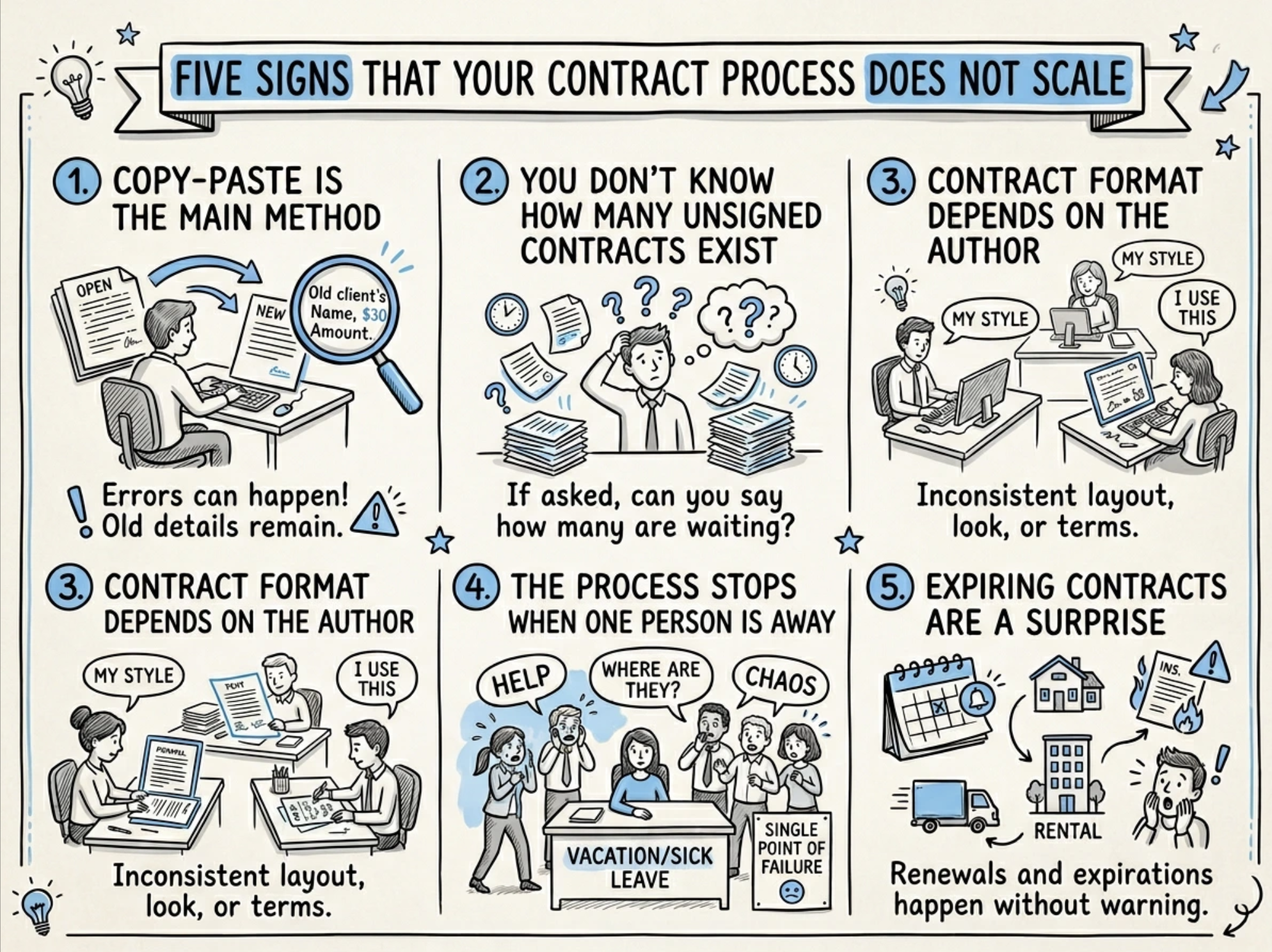
Most companies don't notice the problem until something goes wrong. A client receives the wrong contract. An employee's contract contains the previous person's salary details. Or you discover during a quarterly audit that some contracts have simply gone missing.
Here are five common signs that your contract process needs standardization.
First: copy-paste is your primary contract creation method. Every time someone opens an old contract and starts replacing data, there's a risk that the previous client's name, amount, or date remains in the text. This isn't a hypothetical risk — it happens constantly, and the consequences range from embarrassment to legal issues.
Second: you don't know how many contracts are currently unsigned. If someone asked you tomorrow how many contracts are awaiting signatures, could you answer? Most companies with 10–50 employees can't, because the information is scattered — in someone's email, on someone's computer, in someone's Excel spreadsheet.
Third: contract format depends on who created it. One colleague's contracts look one way, another's look different. Some use the company letterhead, some don't. Some include a GDPR clause, some forget. Format differences aren't just an aesthetic problem — they indicate a lack of unified standards.
Fourth: everything stops when a colleague is on vacation. If only one person knows where the contracts are and how to create them, you're one sick day away from chaos. This is the classic "bus factor" problem — what happens if that person isn't at work tomorrow?
Fifth: expiring contracts come as a surprise. Supplier contracts, lease agreements, insurance policies — they all expire at some point. If you're not actively tracking them, you'll only find out when it's already too late to negotiate the best terms.
If you recognized yourself in at least two of these points, it's time to think about standardizing your process.
Why email and shared folders don't work
Many companies try to solve the problem with what they already have. They create a shared folder on Google Drive or OneDrive. They build an Excel spreadsheet to track contracts. They send reminders through Outlook.
This works as long as everyone diligently follows the process. But the reality is that people are busy and forget things. Someone forgets to save the file to the folder. Someone forgets to update the Excel sheet. Someone sends a reminder but gets no response, and the matter is forgotten.
The problem isn't the people — it's the system. A manual process depends on every person doing the right thing every time. But the more steps and people in the process, the greater the probability that something goes wrong.
The template-based approach: one source, one standard
The most effective way to standardize your contract process is through templates. Not Word files in a shared folder, but a unified system where templates are always up to date and everyone uses the same version.
Think of it this way: instead of each colleague copying their last contract and customizing it, you have one place where all contracts originate. An employment contract template, a service agreement template, a partnership agreement template — each with a defined structure, correct clauses, and current wording.
When a template changes — for example, a new GDPR clause is added or the company address changes — you update it in one place and all future contracts automatically use the new version. No need to email everyone asking them to "please use the new template from now on."
The HR manager at PROTO Discovery Centre shared their experience of how they did everything manually before Agrello — every employment contract took time to prepare, required manual data entry, and constant monitoring. After adopting templates, contract preparation dropped to a few minutes and the error rate fell to near zero.
How to give your team freedom without adding chaos
Standardization doesn't mean taking control away from your colleagues. On the contrary — it means giving them the tools to act independently and confidently.
Imagine your HR specialist needs to prepare contracts for 8 new employees. In the old process, that means: open the last file, copy, change the name, change the date, change the salary figure, save, send for signing, track who has signed. Repeat 8 times.
In a template-based process, they select a template, enter the data, and the system generates all 8 contracts at once. It sends signing invitations automatically. It notifies when someone hasn't signed. And it archives the completed contracts automatically.
This isn't the distant future. This is what companies that have decided to standardize their contract process are already doing today.
It's important to understand that standardization doesn't require expensive enterprise CLM software (contract lifecycle management) that costs thousands of euros per month and needs an IT team to implement. For small and medium-sized companies, a simple solution that covers the basics is enough: templates, signing, tracking, archiving.
A practical action plan: how to get started
If you feel your company's contract process needs tidying up, here's a simple action plan you can implement right away.
Step one: map your existing contract types. Make a list of all contracts your company regularly uses. Employment contracts, service agreements, partnership agreements, NDAs, lease agreements — everything. Most companies have 5–10 core contract types that they use repeatedly.
Step two: create a template for each contract type. Take your best existing contract, strip out the client-specific information, and turn it into a template. Mark the places where variable data goes — name, date, amount, special terms.
Step three: centralize your templates. This could be a contract management platform like Agrello, where templates are accessible to everyone and always up to date. The key is that it shouldn't be someone's personal computer or email attachments.
Step four: agree on a process with your team. Who creates which contracts? Who reviews before sending? Where do contracts go for signing? Where are completed contracts stored? These four questions need clear answers.
Step five: monitor and improve. The first month is always experimentation. Ask your team for feedback — what works, what doesn't? Adjust templates and processes accordingly. Standardization isn't a one-time project — it's an ongoing process.
What are the results?
Companies that have standardized their contract process typically report three concrete outcomes.
First, time. Contract preparation that used to take 20–30 minutes now takes 2–3 minutes. If you prepare 20 contracts per month, that's 6–9 hours saved monthly — nearly a full working day.
Second, quality. When all contracts come from the same template, the format is consistent, clauses are correct, and there are fewer errors. This isn't just an aesthetic matter — it's legal certainty.
Third, transparency. At any moment, you know where every contract is — whether in preparation, awaiting signature, or in the archive. No need to ask anyone, no need to check an Excel spreadsheet.
Start small, but start
Standardizing your contract process doesn't have to be a big project. You don't need to buy expensive software, hire a consultant, or reorganize the entire company. Start with one contract type — for example, employment contracts. Create a template, try it for a week, see how it works. Then add the next contract type.
Agrello is built for exactly this kind of approach. You can start with a free 14-day trial, upload your existing templates, and begin using it immediately. No IT department needed, no lengthy implementation.
Try Agrello free for 14 days and see how much time your team actually spends on contracts — and how much of that could be saved.
Frequently Asked Questions
What is contract process standardization?
Contract process standardization means creating a unified system for drafting, signing, and managing contracts. Instead of each team member using their own method, you establish shared templates, a clear workflow, and one central place to store contracts.
When should a company standardize its contract process?
When more than 2–3 people handle contracts and problems like lost files, outdated templates, or inconsistent formatting start appearing. The need typically becomes critical when a company grows beyond 10–15 employees.
Does standardizing contracts require expensive software?
No, you can start standardizing with simple tools. Agrello offers contract template creation, digital signing, and contract management in one place — without the price tag of enterprise CLM software. You can start with a free trial.
How do contract templates help reduce errors?
Templates ensure every contract contains the correct clauses, up-to-date wording, and a consistent format. Errors common with copy-paste — like leaving a previous client's details in the document — disappear because variable data is entered into dedicated fields.
How much time does contract standardization save?
Average contract preparation drops from 20–30 minutes to 2–3 minutes. If you prepare 20 contracts per month, that's 6–9 hours saved monthly — nearly a full working day.
How do you start standardizing your contract process?
Start by mapping your existing contract types. Create a template for each type, centralize templates in one place (like Agrello), agree on a clear process with your team, and gather feedback during the first month to improve.
Ready to get started?
Join Agrello and manage your contracts the smart way.