Which level should each agreement use?
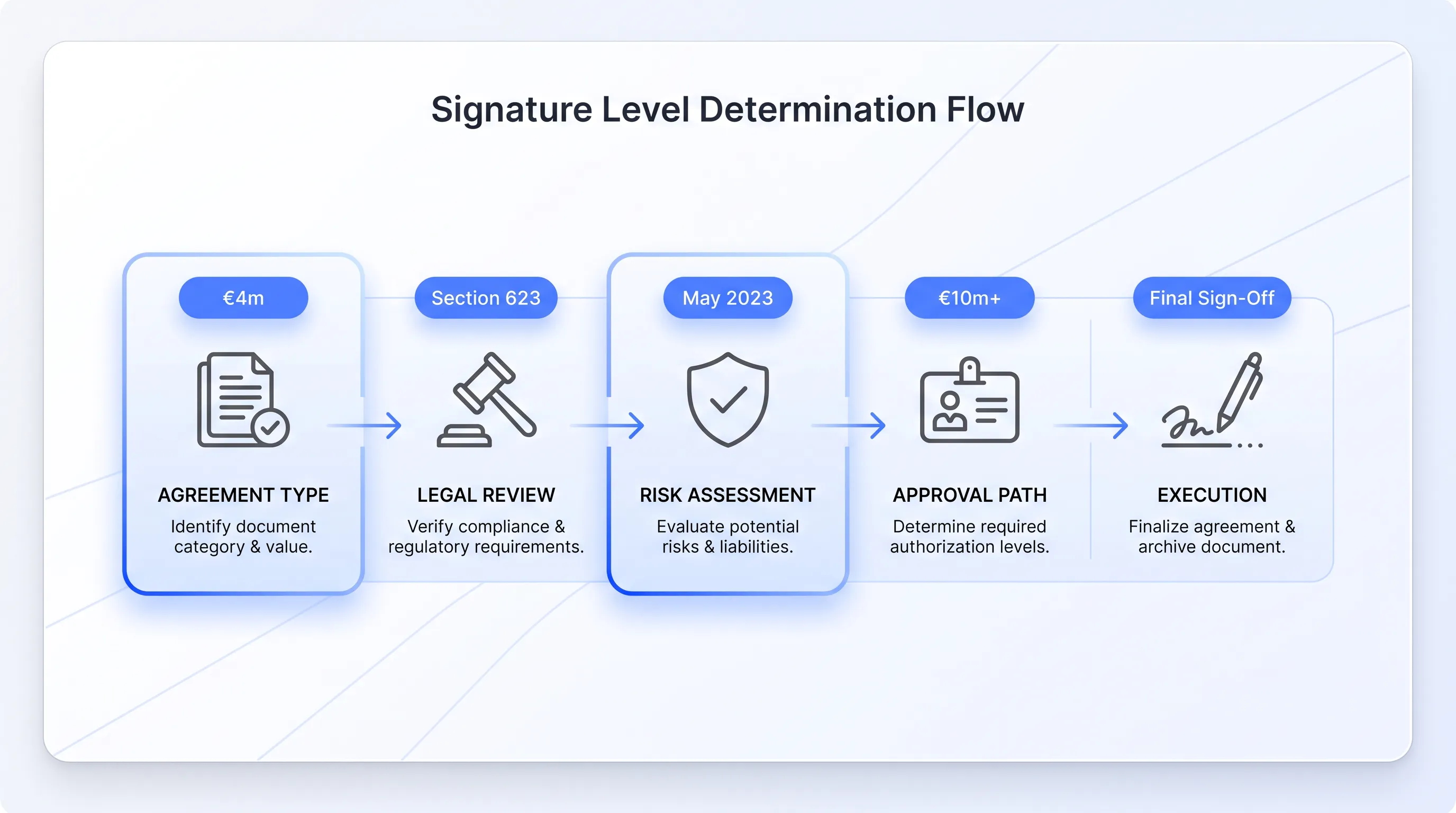
Use a test. Document lists go stale the moment you enter a new market or a new sector rule lands. A test survives because it asks the same questions about whatever lands in the queue.
Run each agreement type through three checks before you assign a level:
-
What happens if the signer denies signing, and what would you need to show?
-
Does any law or sector regulator prescribe a form for this document?
-
How long must the evidence stay verifiable after signing?
The amended Regulation nudges in a specific direction here. Member States are encouraged to consider advanced signatures for day-to-day transactions where they provide sufficient security and confidence.
Read that as a signal about proportionality. Defaulting everything to QES is a real cost in abandoned signing sessions, and defaulting everything to SES is a real cost in disputes you can't win. Route anything touching statutory written form or regulated transactions to legal review rather than guessing.
What identity evidence is necessary?
Match the verification to what an impersonator would gain. A low-value service renewal and a €4m share transfer carry different incentives, so they warrant different proof that the person at the keyboard is who the file says.
ETSI TR 119 460 treats identity proofing as a question of assurance level and notes that requiring a digital signature from an applicant is a highly relevant means of confirming identity, with policy requirements set on the certificate's quality level.
Signer authority deserves its own check, separate from identity. Verifying that Anna signed is not the same as verifying Anna could bind the company, and eIDAS proves the first while saying nothing about the second. Where mandate matters, pair the signature level with a board resolution or a registry extract in the same file.
What integrity evidence is necessary?
Decide how long the signature has to remain verifiable, because that drives the format more than the level does. Certificates expire and revocation data disappears, so a signature that validated in 2026 can fail validation in 2033 without anyone touching the document.
ETSI EN 319 142-1 defines four levels of PAdES baseline signatures with incremental requirements for maintaining validity over the long term, each building on the one below it.
If you have retention duties measured in decades for pensions or property, the long-term variants are the difference between an archive and a folder of unverifiable PDFs. Ask whether your platform applies timestamps and embeds validation data at signing, or whether it expects you to do it later.
Which laws govern the agreement?
Start with governing law, then check where the signer physically is, because both can impose form rules and they don't always agree. Sector regulation adds a third layer that contract law alone won't surface.
Employment law shows how sharp these rules get. The Mecklenburg-Vorpommern Regional Labour Court ruled in May 2023 that an agreement giving an employee the right to terminate early is subject to the written form requirement of Section 623 of the German Civil Code, as Deloitte Legal Germany reported.
Note what that case turned on. The issue was whether the document fell inside a statutory form category in the first place. Which means the jurisdiction question has to be answered before the signature question, every time. Build the governing-law check into your contract intake, and your signature level follows almost automatically.
How should this framework stay current?
Date-check your sources annually, because the eIDAS framework is mid-revision and the implementing acts are still landing. Separate what the Regulation requires from what your policy recommends, and label the second clearly so nobody mistakes internal preference for legal obligation.
Two deadlines matter right now. Regulation (EU) 2024/1183 requires every Member State to provide at least one European Digital Identity Wallet by the end of 2026, and wallet users will be able to sign with legal validity free of charge.
That second detail is the one worth planning around. When qualified signing stops being a paid credential and becomes a wallet function, the friction argument against QES weakens considerably, and policies built on "QES is too hard for signers" will need revisiting. Review this page against European Commission and ETSI publications each year. Narrower pages on QES and PAdES should link back here.
Can Agrello support your signing policy?
Yes, if what you need is signing workflows with identity-linked events and records you can show to someone who wasn't in the room. Agrello is a document management and e-signing platform built in Estonia, listed among the country's business solutions in the e-Estonia DigiExpo catalogue.
Before you compare vendors, write down what your policy actually requires. Which agreement types need verified identity. Which need long-term validation data embedded at signing. Which fall under a written-form rule that only QES satisfies.
Then bring that document to a conversation with Agrello and ask which signing methods are available for your signers' jurisdictions and how audit history is recorded. A format label is not a validity guarantee, and any vendor worth working with will tell you the same thing.