Contract Repository Software: What to Evaluate Before You Buy

Content authorToomas PihlPublished onReading time13 min read
Title:
Contract Repository Software: What to Evaluate Before You Buy

Meta description:
Learn how to score contract repository software options so you pick the right tool for your signed agreements.

This article is a buyer's guide for teams that want their signed agreements out of shared drives and into one searchable digital contract repository. It covers what to test during demos and how to score shortlisted products against your current setup.

Choosing contract repository software

The right way to evaluate contract repository software is to judge it on retrieval and metadata quality, then on ownership and access control. Reminders and audit evidence matter, as do integrations and how easily you can leave. Storage is the cheapest part of the problem. Any tool can hold files.

The scope here is deliberately narrow. This guide is about a repository for agreements that are already signed. A full contract lifecycle management (CLM) platform sits outside this scope. If your operations team is spending Tuesday afternoons hunting for a supplier agreement that someone saved as "final_v3_SIGNED.pdf," contract repository software solves that. Enterprise CLM solves a different and more expensive problem.

Deloitte and World Commerce & Contracting found average contract value erosion of 8.6% of contract value from data on more than 1,200 organizations, with the best performers under 3%. Most of that leakage happens after signature.

Map your use cases

Before you look at contract repository software, write down what your team actually does with contracts. An operations team consolidating signed customer agreements and supplier contracts has a specific set of moments where a contract gets touched. Those moments are your requirements.

Start with the people. Who uploads a signed agreement, and how does it reach them? Finance needs to check a payment term. A manager wants to know when a supplier agreement auto-renews. Human resources has to produce an employment contract during an audit. Each of those is a different retrieval path, and a repository that handles one well can handle another badly.

Write your list in this shape:

  1. The contract type and its typical volume per year

  2. The person who owns the record after signature and the person who acts when a date approaches ава

  3. The two or three questions people ask about that contract type most often

That last item is the one buyers skip, and it's the one that predicts whether a digital contract repository will be used or abandoned. If the recurring question about supplier agreements is "what's our notice period," then notice period has to be a field you can filter on.

Check the repository model

Every contract repository software organizes contracts around some underlying structure, and that structure either matches how your team thinks or fights it. Some tools are folder-first, which feels familiar because it mirrors the shared drive you're escaping. Others are record-first, where each contract is an object with fields and the folders are just one view of it.

Folders alone break down at scale, because a single agreement belongs in several places at once. A master services agreement with a customer is a sales document and a finance document. It is a legal document too. Ask the vendor to show you how one contract appears to three different teams without three copies existing.

Then push on the messier parts of the model:

  • Versions and amendments. When a contract gets amended twice, does the repository show one record with a history, or three unrelated files?

  • Attachments. Signed purchase orders and signature evidence need to sit with the parent agreement.

  • Duplicates. Migration will surface the same PDF three times. Ask what happens then.

  • Links between related agreements. A framework agreement and its statements of work have to be connected, or renewal decisions get made on incomplete information.

The test is whether the model still makes sense at ten times your current volume. A structure that works for 200 contracts and collapses at 2,000 is a structure you'll pay to migrate out of in two years.

Test daily retrieval
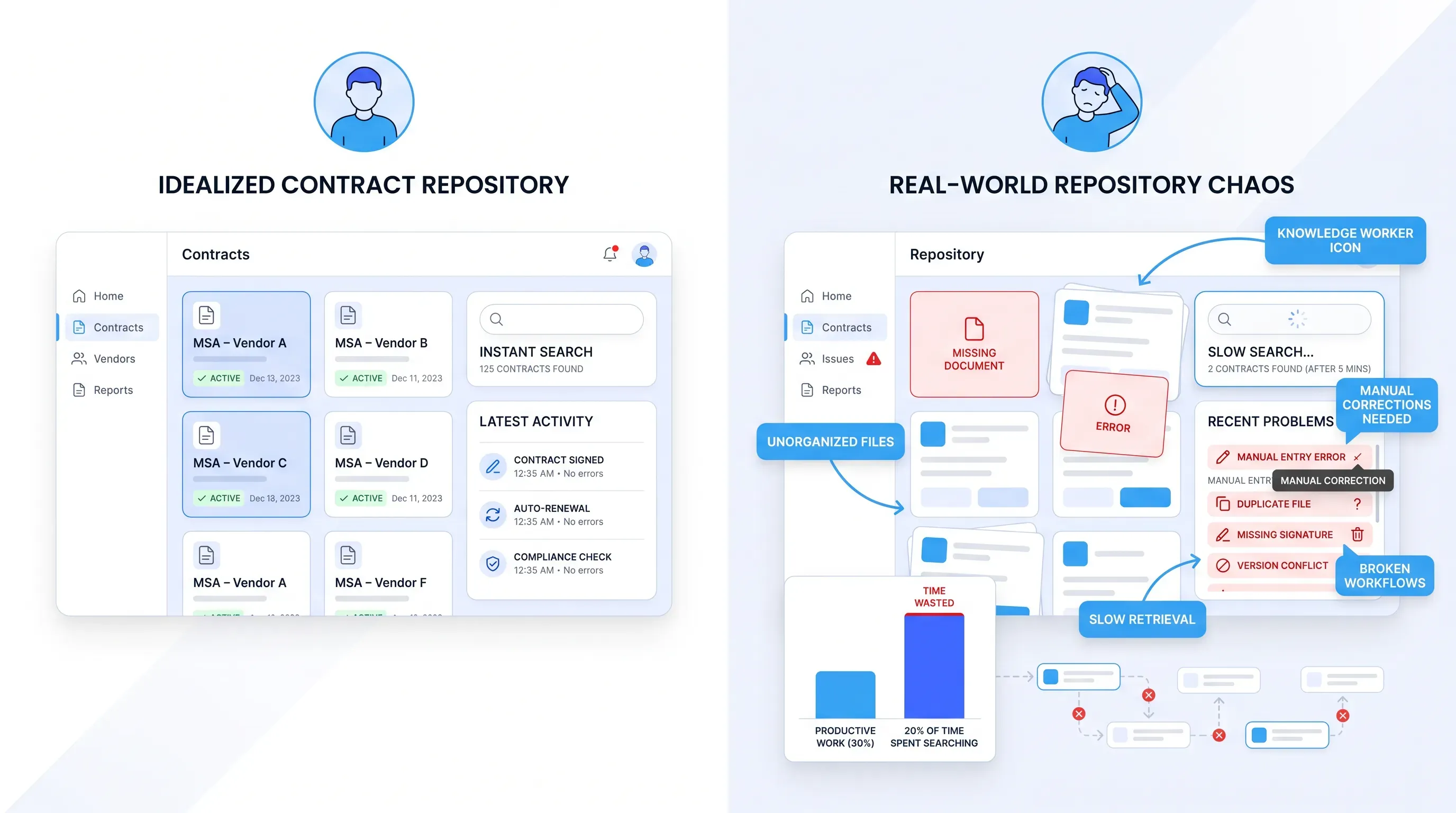
A split-panel SaaS marketing visual contrasting a clean contract repository UI with a cluttered real-world repository interface.

Demos are designed to succeed. The vendor loads a clean sample set with tidy filenames and consistent metadata, then finds a contract in four seconds. Your files don't look like that. Insist on a demo that uses a batch of your own migrated documents, among them the badly named scans and the duplicates.

The McKinsey Global Institute estimated that knowledge workers spend about a fifth of their time searching for and gathering information, roughly one day a week. Contract repository software that only shaves the easy searches isn't earning its cost.

Here's what to run during that session. Search for a term you know appears inside a scanned PDF, not in the filename, and see whether optical character recognition (OCR) picked it up. Filter for every agreement expiring in the next 90 days. Find all contracts owned by a person who left last quarter. Then take a record with wrong metadata and correct it, and count the clicks.

That last test tells you more than the search speed does. Every digital contract repository degrades as people upload things in a hurry, so the question is how cheap it is to fix a bad record. If correcting a counterparty name takes an administrator six steps and a support ticket, your data quality will slide within months. Ask whether the system supports saved views, because a supplier manager who has to rebuild the same filter every Monday will go back to email.


Cut contract signing time by 60%

See how Agrello can automate your contract workflows from creation to e-signature in one free consultation.

Assess control and evidence

Retrieval gets your team using the system. Control is what makes it trustworthy enough to hold employment contracts and commercially sensitive supplier terms. These capabilities need testing at different depths, so treat them separately rather than as one line item labeled "security."

Digital contract repository access

Permissions are where most shared-drive setups have already failed invisibly. Verizon's Data Breach Investigations Report found that human-element breaches make up 68% of total breaches, according to Forrester's analysis of the definitions in use.

Ask how roles work, then ask what happens below the role level. Can you restrict a folder to the finance team while letting one salesperson see a single customer agreement inside it? Can an external counterparty receive a link that expires? Commission Implementing Regulation (EU) 2024/2690 requires organizations in scope to assign and revoke access rights based on need-to-know and least privilege, which is a reasonable standard to hold a vendor to even if the regulation doesn't apply to you.

Test four situations during the trial:

  • An employee who should see their own department's contracts and nothing else

  • A manager who needs read access across departments but shouldn't be able to delete

  • An administrator who can reassign ownership in bulk

  • A departing employee whose access is revoked while the records they owned stay intact

That fourth scenario catches contract repository software where deleting a user orphans their documents. It happens more than vendors admit.

Reminders and ownership

A renewal date sitting in a metadata field does nothing. What matters is whether a named person receives a notice with enough lead time to act, and whether anyone notices when they don't.

Check that you can configure more than one date type per contract, because expiry and renewal notice deadline rarely fall on the same day. Then check who receives the alert. A reminder that goes to a shared inbox is a reminder nobody owns. Ask whether the system escalates to a manager after a set number of days, and whether ownership can be reassigned in bulk when someone changes role.

The proof point is simple. Set a renewal reminder on a contract in the trial and confirm you can answer this question from the record itself: who is responsible for the next action, and what is it? If the answer requires a conversation, the reminder feature is decoration.

Audit history and exports

Audit history is what turns a folder of PDFs into evidence. You want a timestamped record of activity on each file, and you want to be able to export it without asking support.

Signature evidence deserves separate attention. Under Article 25 of the eIDAS Regulation, a qualified electronic signature has the equivalent legal effect of a handwritten signature across all EU member states, and a signature isn't denied legal effect merely for being electronic. For that to help you three years later, the contract repository software has to preserve the validation material. ETSI EN 319 142-1 specifies how PDF Advanced Electronic Signatures (PAdES) store validation data in a Document Security Store so signatures remain verifiable over the long term. Ask whether the vendor keeps the signed original bit-for-bit or generates a rendered copy.

Retention behavior is the last piece. Confirm what happens to audit logs when a document is deleted, and whether the system supports deletion in a way that satisfies Article 17 of the General Data Protection Regulation (GDPR), which gives a data subject the right to obtain erasure without undue delay on specified grounds. Employment contracts contain personal data, so this isn't a theoretical concern.

Cut contract signing time by 60%

See how Agrello can automate your contract workflows from creation to e-signature in one free consultation.

Review integrations

Integrations are where evaluations go wrong, because vendors use one word to describe four different things. A native integration means the two systems talk directly and you configure it in an afternoon. An add-on means a paid module. Middleware means you'll be paying a third party like Zapier or building against an application programming interface (API). Roadmap means it doesn't exist.

Judge each connection against a workflow you can name:

  • E-signature. If contracts are signed in one tool, the executed file and its signature evidence should land in the digital contract repository automatically. Manual re-upload is where records go missing.

  • Email. Most signed agreements arrive as attachments. Forwarding to a repository address beats downloading and re-uploading.

  • Customer relationship management (CRM) and human resources systems. These hold the counterparty and employee data your metadata depends on.

  • Finance. Payment terms and renewal dates matter more to finance than to anyone else in the building.

Ask for the API documentation before you buy. A vendor who won't share it is telling you something. And ask what an integration costs, because "we integrate with Salesforce" occasionally means "our enterprise tier integrates with Salesforce."

Plan migration and exit

Migration is the part of the project that determines whether contract repository software gets adopted, and it's the part nobody budgets for. Gartner Peer Community contributors put data migration at 10-15% of overall project cost on enterprise resource planning programs, which is a useful anchor even at a smaller scale.

Do the inventory first. Count what you have and identify duplicates. Decide which contracts are dead. Then map your metadata: which fields you'll populate on every record and where the values come from. Assign an owner to every contract before import rather than after, because unowned records never get claimed. Run a pilot with one contract type and validate it against the source files. Only then move the rest.

Adoption follows from the pilot. If the first group of users can find what they need on day one, the rest of the organization follows. If they can't, you'll be maintaining two systems for a year.

Now plan the exit, while you still have leverage. Ask for a bulk export during the trial and check what you get: are the original files intact, and does the metadata come out as a usable comma-separated values (CSV) file? The EU Data Act sets a direction here, since from 12 January 2027 providers of data processing services can't impose switching charges on customers. GDPR Article 20 already requires personal data to be provided in a structured, commonly used and machine-readable format. Get the vendor's deletion commitment after termination in writing.

Score contract repository software

Score the contract repository software. A comparison on feel means whichever demo you saw last wins. The weights below reflect what breaks first in a repository-focused deployment, and you should adjust them to your own use cases from the mapping exercise.

CriterionWeightWhat you're scoring
Retrieval20%Full-text search on your own migrated files, filters, saved views
Metadata and record model15%Field flexibility, amendments, linked agreements, correction effort
Access control12%Roles, folder and document permissions, external sharing, offboarding
Reminders and ownership12%Multiple date types, named recipients, escalation, reassignment
Audit history and evidence12%Activity log, signature preservation, exportable reports, retention
Integrations10%Native connections to the systems in your named workflows
Migration and exit9%Import tooling, validation, bulk export, fees, deletion
Usability6%Whether an occasional user can find a contract without training
Cost4%Total over three years, including tiers and per-user creep

Score each criterion from 1 to 5 against a written definition of what a 3 looks like for your team, then multiply by the weight. Do it while the trial is open.

Set your deal-breakers separately from the scoring, because a weighted total can hide a fatal gap. Common ones: no full-text search inside scanned documents and no bulk export without a fee. Another is no way to revoke access without orphaning records. A product that fails a deal-breaker is out regardless of its total.

One more step that most buyers skip. Score your current setup on the same matrix before you score any vendor. That baseline tells you how much of the gap is a product problem and how much is a process problem you'd carry into any new system.

Compare Agrello plans

Agrello is a document management and e-signing platform built in Estonia, where the national eID scheme for the ID card and Mobile-ID is notified under eIDAS at assurance level high. Signing works through national e-ID or Agrello's advanced electronic signature, and signed documents are stored and shared in digital form. Against the matrix, that covers the audit and evidence row directly, because the executed file and its signature travel together rather than being reunited by hand.

Mapping the rest: templates and folders sit under the record model row, searchable records under retrieval. Reminders sit under ownership and user access under access control. Secure spaces for inviting partners to review and sign address the external sharing test. This isn't enterprise CLM with clause libraries and negotiation workflows, and the guide above argues you shouldn't buy that unless your named use cases demand it. Capabilities last verified January 2026.

Score your existing contract repository software on the matrix first, then run the same scoring against a trial. Compare Agrello plans, or talk to the team about which tier matches your contract volume and the workflows you mapped. Contract repository software earns its keep when the person looking for an agreement stops asking anyone for help.

Cut contract signing time by 60%

See how Agrello can automate your contract workflows from creation to e-signature in one free consultation.

Test contract repository software through a complete working cycle, from upload through later retrieval. Test permission changes separately. Use contracts from your own archive, because clean vendor samples won't expose naming errors or missing metadata. Record the time and steps for each task, then compare the results with your current process.

Include files that reflect your archive, especially scanned PDFs and PDFs created digitally. Add an email attachment or an amended agreement if either is common in your records. The aim is to confirm that documents import and remain searchable on real files rather than on a polished sample set.

Search for a distinctive phrase printed inside a scanned contract, then compare the result with the page image. Also test a counterparty name that contains punctuation or accents. If searches miss text that is plainly visible, staff will have to rely on manual browsing.

Yes. Ask the vendor to reassign records after an owner leaves and to change a field across a defined set. Watch for approval limits and audit entries. This test shows whether administrators can maintain data without editing contracts one at a time, which affects record quality after migration.

No, when your team needs clause libraries, negotiation workflows, or a full pre-signature process. Agrello fits a repository-focused use case where signed documents and signature evidence need a shared home. Evaluate it against the same trial tasks and deal-breakers that you apply to every other option.

Schedule a Meeting

Book a time that works best for you and let's discuss your project needs.

You Might Also Like

Discover more insights and articles