Business professional using AI-powered tools for contract management and document automation for small businesses

How can AI streamline contract management for SMBs?

Managing contracts used to mean dusting off filing cabinets or searching through endless email threads. For small and medium-sized businesses (SMBs), this manual approach creates bottlenecks that slow down revenue and increase risk. Today, artificial intelligence has moved beyond buzzwords to become a practical tool for operations managers and HR leaders. AI helps teams regain control over their documentation. It automates the tedious parts of the lifecycle, from drafting the first clause to securing the final signature. By handing repetitive tasks over to software, businesses can focus on the relationships behind the agreements rather than the paperwork itself.

Content authorBy Toomas PihlPublished onReading time10 min read

Overview

This article explores how AI technology reshapes contract management for mid-market companies, particularly those navigating complex European regulations. We will look at specific ways automation reduces costs and legal risks while improving visibility.

You will learn about the different stages where AI adds value, including drafting, signing, and renewal. We will also clarify the critical differences between SES, AES, and QES electronic signatures under eIDAS regulations. By the end, you will understand how tools like digital signature platforms and AI analysis can turn a chaotic backlog into a streamlined asset.

What is AI contract management?

AI contract management is the use of artificial intelligence and machine learning to automate the lifecycle of legal agreements. It assists businesses by extracting data from documents, assessing legal risk, streamlining approval workflows, and ensuring compliance with regulations like eIDAS. This technology transforms static documents into searchable, actionable data, allowing companies to draft faster, track obligations accurately, and reduce the administrative burden on HR and operations teams.

Accelerating Contract Creation and Drafting

The most time-consuming part of any agreement is often the start. Staring at a blank page or trying to locate the most recent template version is a drain on productivity. AI solves this by acting as an intelligent assistant that drafts compliant clauses in seconds.

Modern tools use Natural Language Processing (NLP) to understand the intent of a contract. Instead of copying and pasting from old documents, you can instruct the software to generate a non-disclosure agreement or an employment contract based on specific parameters. This ensures consistency across the organization.

  • Standardized templates: AI ensures every new document uses the latest approved language.

  • Risk flagging: The software highlights non-standard clauses immediately.

  • Language localization: For European SMBs, AI can help adapt drafts for different jurisdictions.

Recent data highlights this shift in workflow. A report cited by The Economic Times, based on a survey of 1,000 professionals conducted by Smallpdf, notes that 55% of business professionals already use AI to draft, edit, or review contracts, demonstrating how AI tools are becoming embedded in everyday legal workflows. This adoption effectively removes the "writer's block" from legal processes by helping teams generate first drafts, check clauses, and refine agreements faster.

When teams spend less time writing, they can close deals faster. Industry research shows that AI-driven contract automation significantly accelerates drafting and negotiation processes by automating repetitive tasks and generating standardized clauses. This speed is vital for SMBs where agility is a competitive advantage. If you're interested in the practical application of AI tools for contract generation and standardization, check out Learn How AI Tools Like ChatGPT Simplify Employment Contract Management.

Enhancing Visibility and Centralized Storage

One of the biggest risks for growing companies is losing track of what they have signed. Contracts often sit in personal inboxes or scattered hard drives. This lack of visibility makes it impossible to know which obligations are active or when a vendor agreement expires.

AI-powered contract management transforms storage into an active, searchable database. It does not just store the file; it reads it. The AI extracts critical metadata such as effective dates, renewal terms, and payment values, turning unstructured text into structured data.

  • Smart searching: You can search for concepts (e.g., "indemnity clauses") rather than just filenames.

  • Automated tagging: The system categorizes documents by type, vendor, or department automatically.

  • Version control: It tracks changes so you always know which version is the final one.

The impact on the bottom line is clear. Organizations adopting AI-powered contract management report 31% cost savings through smarter automation. When you stop losing contracts, you stop losing money on unwanted auto-renewals or duplicate services.

Furthermore, Sirion reports that organizations adopting AI CLM (Contract Lifecycle Management) report productivity gains of up to 44%. This efficiency comes from eliminating the hours spent hunting for information that should be instantly accessible. For more on the underlying technology that enables these intuitive features, explore AI Technologies Behind Document Automation.

Navigating EU Compliance and Signature Types

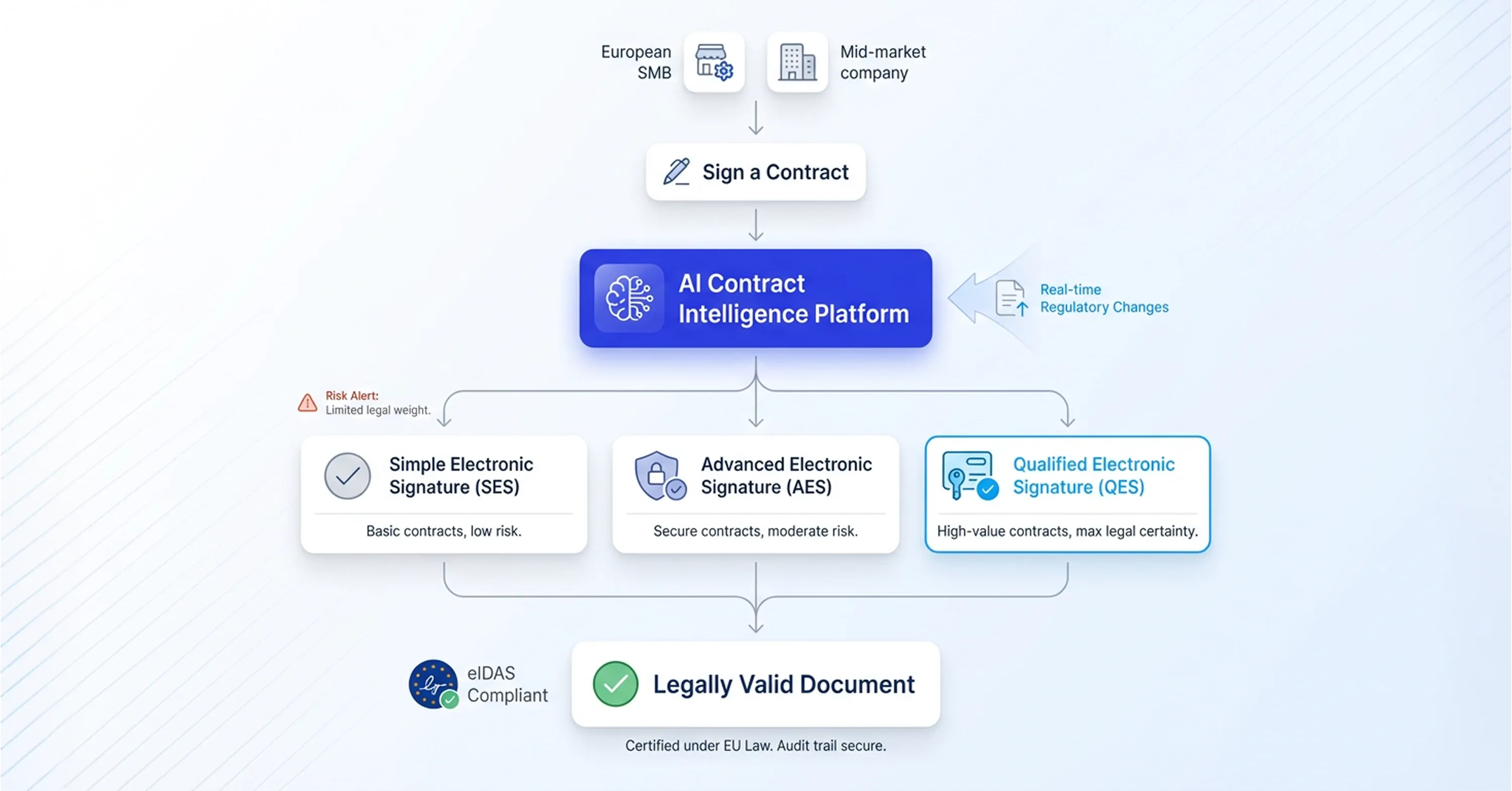
AI contract intelligence platform workflow showing SES, AES, and QES electronic signatures under eIDAS compliance

For European mid-market companies, signing a contract is not just about getting a name on a page. It is about legal validity under the eIDAS regulation. This is where many SMBs struggle, as using the wrong type of signature can render a document invalid in court.

AI platforms often integrate with digital signature tools to guide users toward the correct signature level. Understanding the three types of electronic signatures is essential for compliance:

  • Simple Electronic Signature (SES): suitable for low-risk, day-to-day documents like internal HR memos or basic terms of service.

  • Advanced Electronic Signature (AES): Requires a higher level of ID verification. It is linked uniquely to the signer, making it suitable for substantial commercial agreements.

  • Qualified Electronic Signature (QES): The gold standard in the EU. It requires face-to-face or equivalent video verification and has the same legal status as a handwritten signature.

Agrello plays a vital role here by offering a platform that supports these various signature levels, ensuring that a contract signed in Berlin is just as valid in Paris or Tallinn. By integrating AI, these platforms can suggest the appropriate signature level based on the document type, protecting the business from legal pitfalls.

If you want a deeper dive on legal requirements and differences between signature types, see What Should You Know About eIDAS When E-signing EU Business Contracts.

This guidance is crucial because compliance is not static. Regulations change, and AI helps teams stay ahead of requirements without needing a lawyer for every single transaction.

Streamlining Workflows and Approvals

A contract often stalls because it is sitting in someone's inbox waiting for approval. Manual follow-ups are tedious and prone to human error. AI streamlines this by orchestrating the workflow, ensuring the document moves from person to person without manual intervention.

Automated routing rules mean that if a contract value exceeds a certain amount, the CFO is automatically added to the approval chain. If a standard clause is changed, the legal team gets a notification.

  • Sequential signing: The system routes the document to signers in a specific order.

  • Automated reminders: AI nudges signers who have not taken action after a set period.

  • Audit trails: Every action is logged, providing a clear history of who did what and when.

This level of automation creates a smoother experience for everyone involved and reduces the friction that often delays project start dates. A 2025 State of Contract Management survey by CobbleStone Software found that 95% of contract management professionals are open to using AI in their processes, reflecting growing confidence in automation tools across the industry.

The same survey showed varying levels of adoption: 29% of professionals said they would fully embrace AI, 49% would use it for specific tasks, and 17% remain cautious but supportive of the technology.

This openness is largely driven by efficiency gains. Research from Sirion indicates that organizations using advanced contract automation can see contract negotiation cycles become up to 55% faster, helping teams close deals more quickly and reduce administrative delays.

For more details about automated approval workflows and how they eliminate bottlenecks, read How can AI help me automate document signing?.

Tools like Agrello enhance this workflow by providing a user-friendly interface where teams can manage these approvals effortlessly. When the process is easy, adoption rates go up, and the shadow IT of "signing things via email" disappears.

Managing Renewals and Reducing Risk

The end of a contract's term is just as important as the beginning. Missing a cancellation window can lock an SMB into an unwanted service for another year. Conversely, failing to renew a revenue-generating client contract can hurt cash flow.

AI changes contract management from reactive to proactive. It tracks dates and sets alerts well in advance. Beyond just dates, AI can analyze the risk profile of a contract portfolio. It can identify how many contracts lack a specific liability cap or which vendors are located in high-risk regions.

  • Auto-renewal alerts: Notifications are sent weeks or months before a deadline.

  • Obligation tracking: AI extracts deliverables and deadlines so operations teams know what they need to do.

  • Risk scoring: New contracts are scored based on how much they deviate from standard terms.

The financial upside of this control is significant. AI-powered CLM implementations routinely see first-year ROI exceeding 300%. This return comes from a mix of time saved, risks avoided, and revenue protected.

Additionally, AI-driven solutions deliver 39% faster contract lifecycles compared to manual processes. For an SMB, that speed translates directly to being more competitive in the market.

The Growing Role of AI in Contract Operations

The adoption of AI in this sector is not slowing down. It is becoming the industry standard. Companies that stick to manual processing risk falling behind competitors who can operate faster and with lower overheads.

The global contract management software market was valued at USD 2.40 billion in 2022 and is forecast to reach USD 9.23 billion by 2032. This growth, expected at a CAGR of 14.4%, indicates that businesses are heavily investing in these technologies.

Professionals are also showing strong interest in AI-assisted contract processes. Research from World Commerce & Contracting (WorldCC) highlights growing enthusiasm among practitioners, with many expecting AI to significantly improve contract drafting, risk detection, and operational efficiency.

Integrating AI does not mean replacing legal teams. Instead, it allows legal professionals to focus on higher-value strategic work while automation handles repetitive tasks such as document review, clause comparison, and compliance checks. Industry research shows that organizations implementing AI-enabled contract lifecycle management often achieve measurable ROI within 6–9 months, driven by faster contract cycles and reduced legal workload.

For more forward-looking perspectives on the future of office automation and where e-signing fits, see AI Agents and the Future of Office Automation: Where Does E-signing Fit?.

Conclusion

Artificial intelligence offers a clear path for SMBs to escape the burden of manual paperwork. By automating the drafting, tracking, and signing processes, companies can reduce errors and gain complete visibility over their obligations.

For European businesses, the ability to align these automated workflows with eIDAS regulations is a critical advantage. Tools like Agrello bridge the gap between efficiency and compliance, ensuring that speed does not come at the expense of legal validity. As the market grows and adoption increases, utilizing AI for contract management is no longer just an option; it is a necessary step for building a resilient, efficient business.

Yes, reputable AI contract management platforms prioritize security. They typically use enterprise-grade encryption and comply with strict data protection regulations like GDPR. The AI processes text to extract data but operates within a secure environment. However, businesses should always verify that their chosen provider holds relevant security certifications, such as ISO 27001, to ensure sensitive information remains protected.

No, AI is designed to augment legal teams, not replace them. It excels at repetitive tasks like drafting standard clauses, finding specific dates, or flagging deviations from a template. This frees up lawyers and compliance professionals to focus on complex negotiations, strategic decision-making, and high-stakes risk assessment that require human judgment.

AI helps by identifying the type of document being processed and suggesting the appropriate level of electronic signature required (SES, AES, or QES). It can flag contracts that require a Qualified Electronic Signature for legal validity in the EU, ensuring that teams do not inadvertently sign high-value agreements with a signature type that would not hold up in court.

While enterprise-level systems can be costly, many modern solutions are scalable for SMBs. The return on investment is often realized quickly through time savings and risk reduction. Data shows that AI-powered implementations can see a first-year ROI exceeding 300%, and costs are often recouped by avoiding a single missed renewal or legal error.

Implementation time varies based on the complexity of your current records. However, modern cloud-based platforms are designed for rapid deployment. Many SMBs can start drafting and storing contracts within days. The AI improves over time as it processes more of your specific documents, meaning the system becomes more valuable the longer you use it.

Schedule a Meeting

Book a time that works best for you and let's discuss your project needs.

You Might Also Like

Discover more insights and articles

Smiling man with overlay text about converting a handwritten signature into a digital signature for e-signing documents

How to Turn My Handwritten Signature Into a Digital One

Still printing contracts just to sign them by hand, scan the page, and email them back? For many people, that process still feels normal, but it slows everything down more than it should. The good news is that there’s a much easier way to handle signatures today.

Close-up of professional with overlay text about how AI improves HR document signing processes and digital signature automation

How Does AI Improve HR Document Signing Processes?

Every new hire means a stack of paperwork. Offer letters, tax forms, policy acknowledgments, benefits enrollment, direct deposit authorization. For HR teams managing dozens or hundreds of employees, keeping all of that moving smoothly is a constant challenge.

Woman reviewing signed documents with text about secure storage and management of e-signed documents, representing digital document security solutions.

What's the Safest Way to Store and Manage Signed Documents?

You just got a contract signed. It's locked in, legally binding, and ready to file away. But where exactly does it go, and who can access it six months from now when someone needs it for an audit? More importantly, will you be able to find the right version quickly, prove its authenticity, and show a clear record of who signed and accessed it?

Man signing a document with illustration of cloud workflow, representing automatic document sending for e-signature and digital signing process.

How Can I Send Documents for E-Signing Automatically?

Every week, your team sends the same contracts, NDAs, and approval forms. Someone downloads a template, fills in the names, attaches it to an email, and waits. Multiply that by dozens of documents, and you've built a bottleneck nobody asked for.