How to Choose Contract Repository Software

Content authorToomas PihlPublished onReading time12 min read
Title:
How to Choose Contract Repository Software

Meta description:
Learn how to select a contract repository that fits your operational needs and avoids costly software traps.

Article:
# How to Cho

Choose contract repository software by testing findability and export against your own signed agreements. Storage capacity is the least useful comparison point. Run a pilot with real contracts from your shared drive and confirm you can leave with your data intact.

Which repository use cases matter?

Start with the questions people already ask you about contracts, because those are the use cases the repository has to answer on day one. Someone needs the signed master services agreement with a supplier. Finance wants to know who owns the renewal that's about to auto-extend. Human resources needs the employment contracts locked away from sales.

Those requests reveal the real requirement set far better than a vendor feature list does. The reason this matters financially is documented: World Commerce & Contracting research cited by Deloitte found that 9.2 percent of annual contract value is lost through poor management, with most of that erosion happening after signature.

So the repository you need is a post-signature control system. Write down the five or six retrieval problems you hit last quarter and treat everything else as optional. A wish list built from feature pages will push you toward a product priced for problems you don't have yet, and you'll pay for it in migration effort before you ever see the benefit.

How should the repository model contracts?

The repository should treat each agreement as a record with relationships. An agreement connects to a counterparty and an internal owner, along with dates and a version chain that includes any amendments that changed its terms. Folders are one way to view those records. They shouldn't be the only way.

This distinction has a formal basis. ISO 15489-1:2016, the international standard for records management, separates records from other information assets by their transactional nature and their reliance on metadata to preserve context and apply management rules.

Which gives you a practical test during a demo: ask the vendor to show you every active agreement with one counterparty across three different folders. If the product can only answer that by browsing directories, the model is a file share with a nicer interface. Your reporting will stay manual, and the migration will have moved the problem.

Which metadata fields are essential?

Eight fields carry most of the retrieval and reporting weight. Contract type and counterparty sit alongside internal owner and status, and effective date and expiration date sit alongside renewal terms and links to amendments. Everything else is optional until a specific business question demands it.

The pressure to add fields comes from the belief that richer data is always better. It isn't, because every required field multiplies the manual work of backfilling a legacy archive. A shared drive holding 800 agreements and twelve required fields means 9,600 data points somebody has to enter or verify.

Contracts holding personal data face a separate constraint. Article 5(1)(c) of the GDPR requires personal data to be relevant and limited to what's necessary for the purpose. Capturing extra personal detail as searchable metadata creates exposure you didn't have when the same information sat inside a PDF nobody indexed.

Who maintains repository records?

Every contract needs one named business owner and the repository needs at least one named administrator, with those roles written down before migration starts. The owner answers renewal reminders and confirms the agreement is still active. The administrator manages accounts and decides what happens to records when the owner leaves.

Without that split, records decay quietly. The same ISO 15489 framework cited above lists assigned responsibilities and monitoring as core elements of managing records, alongside the systems themselves.

That's the part software can't supply. A repository with excellent reminder logic and no assigned owner sends alerts into a shared inbox where they die. Before you compare products, sketch a simple map of who uploads agreements and who validates the metadata on upload. If you can't fill those slots with actual names, the tool selection is premature.

Cut contract signing time by 60%

See how Agrello can automate your contract workflows from creation to e-signature in one free consultation.

Search must prove real findability

Test search with your worst files. Pick fifteen agreements from the shared drive that represent the mess: scanned PDFs and files named "contract_final_v3_USE THIS.pdf". Then search for each one by filename and a phrase from inside the document.

Full-text search across scanned documents depends on optical character recognition, so confirm whether the product runs it and on which plan. Deloitte and World Commerce & Contracting research across more than 1,200 organizations found that contract-related data in large organizations sits in 24 different systems on average.

Fragmentation like that is exactly what a repository is meant to end, which is why partial search coverage defeats the purpose. If text search only works on documents uploaded after go-live, your legacy archive stays as unsearchable as it was on the drive. Ask the vendor to demonstrate retrieval on a file you supply, during the trial, and count how many clicks it took.

Permissions should follow contract sensitivity

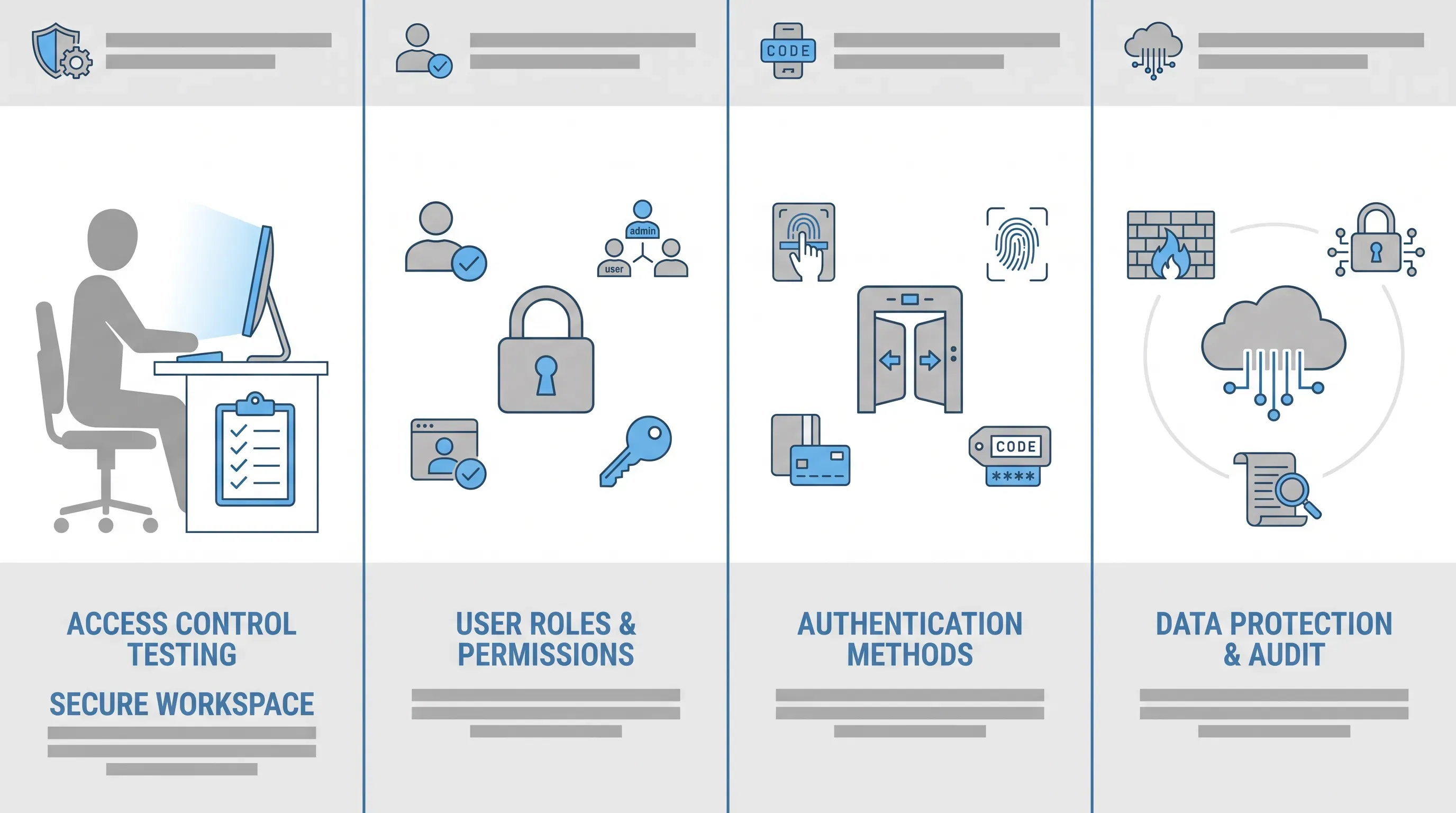
An IT security analyst at a modern desk tests access controls, surrounded by icons of security measures in a clean, corporate workspace.

Access should be granted by role and tightened to the least each person needs, because contract archives mix commercial terms with salary data and personal information. Employment agreements shouldn't be visible to the sales team. Supplier pricing shouldn't be open to everyone with a login.

Least privilege is an established control. NIST Special Publication 800-53 Revision 5 defines it as enforcing the most restrictive set of rights and accesses needed by users to perform their duties.

Test the boundaries you actually have. Create a finance account and confirm it can't open HR folders. Create an external sharing link and check whether it expires and whether it needs a password. Then remove a user and verify what happens to the records they owned. That last test matters more than most teams expect, because offboarding is where repositories leak. A departed employee's shared links survive their account, and a product that can't show you every active external link is asking you to trust it without evidence.

Reminders need owners and escalation

A reminder is only useful when it names a person and a deadline. Configurable alerts for renewals and notice periods are standard across repository products. The differences show up in whether the alert routes to an individual and whether the notice period is calculated separately from the end date.

That last distinction is where money leaks. Deloitte's post-award contract management analysis notes that companies commonly track end dates but fail to monitor the notice period required to terminate or stop an auto-renewal, so they keep paying for services they no longer use.

Configure one live reminder during the trial and let it fire. Check what the email looks like and whether a second alert reaches a manager when the first is ignored. A calendar entry can tell you a contract expires in 90 days. Only a repository that ties the notice window to a named owner will stop the renewal you didn't want.

What evidence does the repository retain?

The repository should keep version history and an audit trail you can export in a readable format. Ask specifically about export, because an audit log locked inside a vendor interface is worth little in a dispute or an audit where you need to hand something over.

Be precise about what those logs prove. They show what happened inside the system. They don't establish that a contract is valid or that your organization is compliant with a given regulation. Under Article 25 of the eIDAS Regulation, a qualified electronic signature has the equivalent legal effect of a handwritten signature across the EU, and legal effect flows from the signature method.

So separate the two questions when you evaluate. One is whether the product records activity in enough detail to reconstruct who did what and when. The other is whether your signing method meets the standard your jurisdiction and counterparties expect. A repository with beautiful logs and a weak signature method leaves you exposed on the point that matters most.

Cut contract signing time by 60%

See how Agrello can automate your contract workflows from creation to e-signature in one free consultation.

Which integrations prevent duplicate work?

Integrate where a document or a date is currently being copied by hand, and skip the rest. The connections that pay for themselves are e-signature, so executed agreements land in the repository automatically, and email or cloud storage, so uploads don't require a detour. Customer relationship management and collaboration tool integrations matter only if your contract flow genuinely runs through them.

Verify how each connection works before you count on it. Native integrations behave differently from application programming interface (API) connections that need developer time, and both differ from a "Zapier-compatible" claim that adds a subscription. Plan gating is common, too. The 24 systems holding contract data in large organizations exist because each tool solved one problem and connected to nothing.

That's the trap worth avoiding at your size. A repository that becomes system number three and requires manual copying into two others produces exactly the fragmentation you're migrating away from. Ask the vendor which integrations sit on your intended plan and which require an upgrade, and get the answer in writing.

Can the team migrate and leave?

Test the exit before you commit to the entrance. Bulk import and full export with readable audit data are things you should confirm with your own files during a trial.

Run a pilot of 50 to 100 representative agreements. Include the scanned ones and the duplicates. Document every error and how you fixed it, then decide whether the full archive is a weekend of work or a quarter. Gartner's research on enterprise systems found that data integration with legacy sources can result in data inaccuracy or loss, which is a risk that scales with how little you tested first.

Then export everything and open it. If the export gives you files without metadata, or a comma-separated file with no link back to documents, you're locked in regardless of what the contract with the vendor says. Portability is a feature you only discover you lack at the worst possible moment.

A weighted scorecard exposes tradeoffs

A scorecard forces the comparison that demos avoid, because it makes you rank what you'd give up. Score each product from 1 to 5 on twelve criteria and multiply by your weight. Every score needs evidence from a test you ran.

Use these as your criteria and adjust weights to your own situation:

  • Findability, metadata structure, ownership assignment, and permissions

  • Reminders with escalation, evidence and audit history, and integrations that match your workflow

  • Migration and export, everyday usability, security posture, and total cost across the plan you'd actually buy

The evidence requirement is what makes this work. Deloitte and WorldCC found that only a third of companies can measure the financial value or business impact of their contract management investment, and part of that gap starts at selection, when nobody wrote down what the tool was supposed to fix. A scorecard filled in during trials becomes the baseline you measure against a year later.

How should teams assign weights?

Weight highest whatever failed most expensively in the last twelve months. If you missed a renewal notice window, reminders carry the heaviest weight. If a spreadsheet of contract dates was wrong during an audit, evidence and metadata rank first. Cost and usability matter, but they rarely belong at the top for a team migrating off a shared drive.

Score against scripted tests. Write the task ("find the 2023 amendment to the Nordics distribution agreement") and run it in each product.

The discipline pays off in the second round of evaluation, when three products look similar and the sales conversations start blurring together. Documented test results from week one settle arguments that feature comparisons can't, and they protect the decision from whoever demos last and most persuasively.

What indicates best fit?

A focused repository fits when your problem is post-signature: finding executed agreements and catching renewals. Those needs are well served by products built around storage and retrieval, and they're the needs most growing operations teams actually have.

Mark a repository as the wrong fit when the requirement list drifts pre-signature. Complex intake forms and redline negotiation with counterparties belong to enterprise contract lifecycle management (CLM). Deloitte and WorldCC's research covering more than 1,200 organizations frames contract value erosion as a whole-lifecycle problem, which is exactly why enterprise CLM exists.

Scale determines which half of that lifecycle you should solve first. A 40-person company buying enterprise CLM to fix a findability problem ends up with an implementation project instead of a working archive. Solve the post-signature gap, then reassess when negotiation volume justifies more.

Is Agrello a practical next step?

Agrello is worth a trial if you're a small or mid-sized business that needs reminders and searchable records in the same place you collect signatures. It's a document management and e-signing platform, and it covers the post-signature control described throughout this article.

The signing side is where jurisdiction matters. Agrello supports national electronic identity signing alongside its own international advanced electronic signature, and the two carry different legal weight based on where you and your counterparty are. Confirm which method your agreements require before you standardize on one.

A few things to check directly on Agrello's contract management and pricing pages, since plans change:

  1. Which plan includes reminders and the user seats you need

  2. Whether bulk import and export match the migration tests described above

  3. Which signing methods are available for your jurisdiction and counterparties

Run your pilot archive through it and compare the result to at least one alternative before you move the full drive.

Cut contract signing time by 60%

See how Agrello can automate your contract workflows from creation to e-signature in one free consultation.

Retain expired contracts for the period required by applicable law, tax rules, limitation periods, and your records policy. The correct period depends on the contract type and jurisdiction. Set a retention date when you archive the record, then suspend deletion if a dispute, audit, or legal hold applies.

Keep one authoritative copy of the executed agreement and link related copies only when they add evidence, such as a signed scan or an email attachment. Mark duplicates clearly and prevent them from triggering separate reminders. Compare signatures, dates, and amendment references before you delete any file.

You can use AI-assisted extraction to speed up data entry, but a named reviewer should verify every field that drives reporting, access, or reminders. Test it against your scanned and poorly named agreements first. Record who approved corrections, since inaccurate dates and owners can create missed obligations.

Archive a terminated agreement after you record the termination date, the reason, and any obligations that survive termination. Remove it from active renewal reporting, but keep it searchable during its retention period. Preserve amendments, notices, and the final signed version with the archived record.

Keep emails that change the agreement’s meaning or provide evidence of approval, delivery, termination, or a dispute. Routine scheduling messages usually don't belong in the contract record. Apply the same retention and access rules to stored correspondence, especially where it contains personal or commercially sensitive information.

Schedule a Meeting

Book a time that works best for you and let's discuss your project needs.

You Might Also Like

Discover more insights and articles