Overview
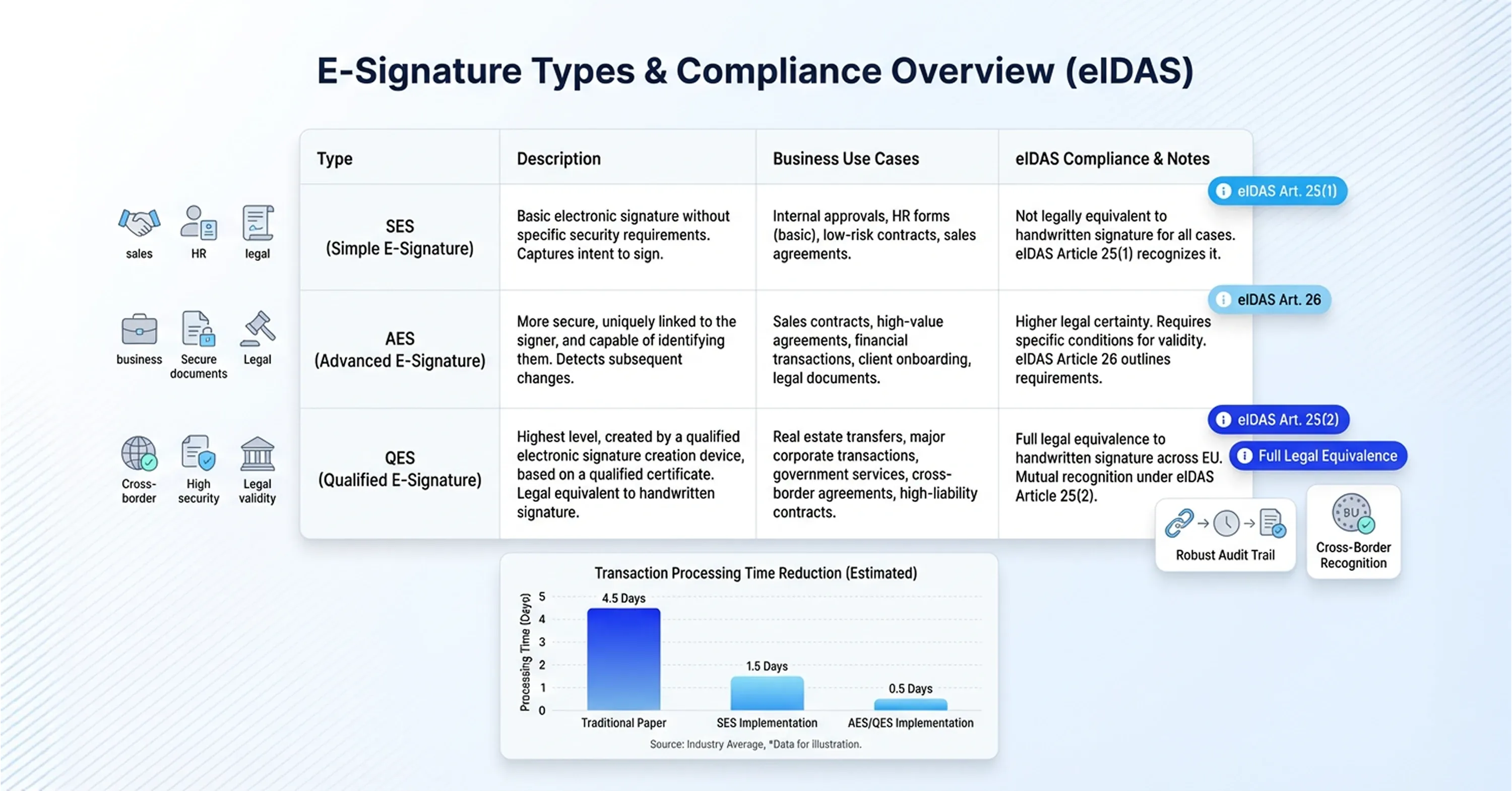
Electronic signatures are legally recognized across the European Union, but not all signatures carry the same level of legal validity. Under the eIDAS regulation, the EU defines three types of electronic signatures - Simple (SES), Advanced (AES), and Qualified (QES) - each designed for different levels of security and legal assurance.
In this article, you will learn:
-
What the EU eIDAS regulation requires for electronic signatures
-
The differences between SES, AES, and QES
-
Which signature type is appropriate for various business and legal documents
-
How organizations can stay compliant when signing contracts across EU member states
By understanding these requirements, businesses can choose the right signing method while ensuring their documents remain legally enforceable across the EU.
Understanding the EU eIDAS Regulation
To grasp the legal requirements for digital signatures in the EU, you must first understand the foundation of these laws. The European Union established Regulation (EU) No 910/2014, commonly known as eIDAS. This regulation created a standardized framework for electronic identification and trust services across all member states. Its primary goal is to ensure that electronic interactions between businesses, citizens, and public authorities are safer and more efficient.
For a deeper look at the current regulatory landscape - including how the eIDAS 2.0 initiative expands identity and signature rules - read eIDAS 2.0: The Future of EU Digital Identity and Authentication by 2030.
The eIDAS regulation applies directly to every EU member state. This means it supersedes conflicting national laws regarding electronic identification. It was designed to facilitate cross-border business by ensuring that a signature created in one country is recognized in another. However, eIDAS does not treat all electronic signatures equally. It establishes three specific tiers of signatures. Each tier offers a different level of security and legal weight.
-
Standardization: Creates a single market for trust services.
-
Legal Certainty: Ensures electronic signatures are admissible as evidence in court.
-
Tiers: Defines Simple, Advanced, and Qualified levels.
Understanding these tiers is essential for compliance. Using the wrong type of signature on a high-stakes document could render it unenforceable. The following sections will guide you through these three levels so you can match them to your operational needs.
The Three Levels of Electronic Signatures
The eIDAS regulation categorizes electronic signatures into three types: Simple Electronic Signatures (SES), Advanced Electronic Signatures (AES), and Qualified Electronic Signatures (QES). The main difference between them lies in how securely they verify the signer's identity.
Simple Electronic Signatures (SES)
Simple Electronic Signatures are the most basic form of digital assent. The law defines them broadly as data in electronic form which is attached to or logically associated with other data and which is used by the signatory to sign. This covers a wide range of common actions you likely perform every day without thinking twice.
Common examples of SES include:
While SES is easy to use, it offers the lowest level of identity verification. You cannot easily prove who actually clicked the button or pasted the image. Therefore, SES is best suited for low-risk internal documents where the likelihood of a legal dispute is minimal. Eurostat data cited by Fortune Business Insights indicates that about 74% of European SMEs had adopted at least a basic level of digitalization by 2024. Many of these businesses start with SES for routine tasks like approving employee leave requests or acknowledging receipt of company policies.
Despite its convenience, SES may not hold up in court for high-value contracts. If you need to ensure the integrity of the document and the identity of the signer, you must move up to the next level of security.
Advanced Electronic Signatures (AES)
Advanced Electronic Signatures provide a significantly higher level of security than SES. eIDAS sets out four specific requirements that an AES must meet to be valid. If a signature fails even one of these checks, it defaults back to being a Simple Electronic Signature.
To qualify as AES, the signature must be:
-
Uniquely linked to the signatory.
-
Capable of identifying the signatory.
-
Created using electronic signature creation data that the signatory can, with a high level of confidence, use under their sole control.
-
Linked to the data signed in such a way that any subsequent change in the data is detectable.
This level typically involves digital certificates and encryption technology. Platforms like Agrello utilize these technologies to ensure that when a user signs a document, the system records a digital footprint that links the action directly to their verified identity. This makes AES ideal for the majority of B2B commercial contracts, non-disclosure agreements, and consumer banking documents.
Want more clarity on the legal and practical distinctions between signature types? See What Is a Qualified Electronic Signature? for technical and legal insights.
While AES is robust and widely accepted, it is not the highest standard available. For specific documents that carry significant legal weight or government mandates, the regulation requires the strictest form of signature.
Qualified Electronic Signatures (QES)
Qualified Electronic Signatures represent the gold standard under EU law. A QES is essentially an Advanced Electronic Signature that is created by a Qualified Electronic Signature Creation Device (QSCD) and is based on a qualified certificate for electronic signatures.
The key distinction here is the involvement of a third party known as a Qualified Trust Service Provider (QTSP). The QTSP must verify the signer's identity face-to-face or through a video identification process approved by national authorities.
-
Legal Equivalence: A QES has the exact same legal effect as a handwritten (wet ink) signature across all EU member states.
-
Burden of Proof: With a QES, the burden of proof shifts. If a signer claims they didn't sign it, they must prove it. With SES or AES, the party enforcing the contract must prove the signature is valid.
QES is mandatory for certain high-risk transactions. These often include real estate transfers, certain HR termination notices, and major government tenders. However, the infrastructure for QES varies by country. A 2021 European Commission evaluation noted that Spain had 36 active QTSPs and France had 24, while countries like Denmark had none at the time. This variance can make implementation tricky for pan-European operations.
If you'd like to see specific, real-world examples and how courts judge the validity of e-signatures in practice, check out Electronic Signature Examples (Real Documents, Correct Use Cases).
Now that we have defined the three levels, the next logical step is to understand which one fits your specific business processes.
Matching Signature Types to Use Cases

Choosing the right signature level is a balance between security, user experience, and cost. Requiring a Qualified Electronic Signature for every internal memo would be inefficient and expensive. Conversely, using a Simple Electronic Signature for a multi-million euro merger could be disastrous.
Here is how different departments typically apply the EU eIDAS e-signature law to their workflows.
Human Resources and Employment
HR departments handle a high volume of paperwork that varies in legal sensitivity. For general onboarding documents, employee handbooks, and privacy policy acknowledgments, a Simple Electronic Signature (SES) is usually sufficient. These documents rarely face legal challenges regarding the authenticity of the signer.
However, employment contracts require closer attention. In many EU countries, a standard employment contract can be signed with an AES. Platforms like Agrello help HR teams manage these workflows efficiently by securing the document with AES, which verifies the employee's identity without the friction of a full QES vetting process.
Exceptions exist. Some jurisdictions require a handwritten signature or a QES for specific actions, such as fixed-term contract renewals or resignation letters. HR leaders must check local labor laws to ensure they aren't exposing the company to risk.
Sales and Commercial Agreements
For sales and operations, speed is often a priority. Fortune Business Insights reports that adopting e-signature solutions can cut transaction processing times by up to 40%. To maintain this speed without sacrificing security, Advanced Electronic Signatures (AES) are the standard choice for most commercial agreements.
For detailed, department-specific examples across HR, legal, finance, healthcare, and more, refer to What Is an E-Signature? Define e signature, Meaning & Examples.
Typical use cases for AES include:
-
Master Service Agreements (MSAs).
-
Sales contracts and purchase orders.
-
Non-disclosure agreements (NDAs).
-
Software licensing agreements.
AES provides enough evidence to stand up in court for commercial disputes. It confirms the document hasn't been altered and links the signature to the buyer or partner.
Regulatory Basis for Electronic Signatures in the EU
Electronic signatures used in business workflows across the EU must comply with Regulation (EU) No 910/2014 (eIDAS), which establishes a unified legal framework for electronic identification and trust services across all EU member states.
Under this regulation, electronic signatures are categorized into Simple (SES), Advanced (AES), and Qualified (QES) levels. Each level provides a different degree of identity verification and legal assurance for digital transactions.
For example, Advanced Electronic Signatures must satisfy the requirements defined in Article 26 of eIDAS, meaning the signature must be uniquely linked to the signer, capable of identifying the signer, created under the signer’s sole control, and linked to the document so that any later modification can be detected.
These regulatory requirements ensure that electronic signatures can be used reliably in cross-border digital transactions and legal agreements across the European Union.
Practical Implementation Example
In practice, many organizations implement Advanced Electronic Signatures (AES) for everyday business contracts such as NDAs, service agreements, and employment documents. Under the eIDAS regulation, AES must be uniquely linked to the signer, capable of identifying the signer, created under the signer’s sole control, and connected to the document so that any later modification is detectable.
Modern e-signature platforms support this workflow by generating a digital audit trail that records key evidence such as timestamps, identity-verification steps, and the signer’s IP address. This record helps prove who signed the document, when the signature occurred, and that the document remained unchanged after signing.
Legal and Government Compliance
The strictest requirements apply to legal departments and interactions with government bodies. If a document requires notarization or carries statutory form requirements, a Qualified Electronic Signature (QES) is almost always necessary.
Examples requiring QES often include:
-
Transfer of real estate titles.
-
incorporation of limited liability companies in certain states.
-
Credit agreements in specific consumer finance scenarios.
Using a QES ensures that the document is recognized as valid in every EU member state without discrimination. Article 25 of eIDAS specifically states that a qualified electronic signature shall have the equivalent legal effect of a handwritten signature.
Understanding these use cases allows you to categorize your document library effectively. Next, we will examine the benefits that come from implementing a compliant strategy.
Benefits of a Compliant E-Signature Strategy
Adhering to the legal requirements for digital signatures in the EU is not just about avoiding fines or lawsuits. It is a strategic move that modernizes your business operations. As the market matures, the value of robust digital signing becomes clear. The Europe digital signature market was valued at USD 1.97 billion in 2024 and is projected to grow rapidly, reaching USD 26.80 billion by 2032.
Enhanced Security and Fraud Reduction
One of the most immediate benefits of moving to AES or QES is the reduction in risk. Paper contracts are easily lost, damaged, or forged. Digital solutions leave an audit trail. Data cited by Fortune Business Insights suggests that adopting e-signature solutions can reduce fraudulent activities by as much as 35%.
By using regulated signatures, you ensure:
-
Integrity: You know the document has not been changed since it was signed.
-
Authenticity: You have cryptographic proof of the signer's identity.
-
Non-repudiation: The signer cannot easily deny their involvement.
For an in-depth look at how digital contract security really works and how to evaluate vendors, see Are Your Digital Contracts Secure? A Look into E-signature Security.
Market Access and Efficiency
Compliance with eIDAS opens doors to new markets. Because the regulation harmonizes rules across the bloc, a German company can sign a contract with a French supplier using a QES, and both parties can trust the validity of the document. A survey by the European Commission found that over 50% of trust service providers reported that eIDAS enabled them to increase their EU customer base.
Furthermore, efficiency gains are substantial. You eliminate the costs of printing, courier services, and physical archiving. Contracts that used to take weeks to finalize via post can now be completed in minutes.
While the benefits are clear, there are still challenges to watch out for.
Challenges in Cross-Border Adoption
Despite the intention of eIDAS to create a unified market, reality is sometimes more complex. National interpretations and technical readiness still vary between member states.
Forrester research observed that Europe still lags behind the US in e-signature adoption partly due to inconsistent regulations. While eIDAS sets the baseline, local laws can add specific requirements for certain sectors. For example, a digital mortgage process might work seamlessly in Estonia but face regulatory hurdles in Germany.
Another challenge is the availability of national eID schemes. As of 2021, fourteen EU Member States had notified national eID schemes to the Commission. If your counterparty is in a country without a widely notified eID scheme, setting up a QES workflow might require extra steps, such as video verification with a private provider.
To navigate these hurdles, organizations should partner with versatile e-signature vendors who understand the nuances of the EU landscape. For regional and sector guidance, see Cross-Border Digital Identity and E-signing in the Baltic States: A Practical Guide for SMEs.
Key Definitions
Electronic Signature Types Summary:
-
Simple (SES): Basic electronic data used to sign (e.g., email signature, checkboxes). Good for low-risk, internal use.
-
Advanced (AES): Uniquely linked to the signer and capable of detecting changes to the document. The standard for most B2B contracts.
-
Qualified (QES): Created by a qualified device and based on a qualified certificate. Legally equivalent to a handwritten signature EU-wide.
Conclusion
Understanding the legal requirements for digital signatures in the EU is critical for modern business compliance. The eIDAS regulation provides a robust framework that distinguishes between Simple, Advanced, and Qualified signatures, each serving a distinct purpose.
For most day-to-day commercial operations, an Advanced Electronic Signature (AES) offers the right balance of security and ease of use. However, for critical documents requiring the highest level of legal certainty, investing in Qualified Electronic Signatures (QES) is necessary. By aligning your document workflows with these three tiers, you protect your organization from legal risk while benefiting from the speed and efficiency of digital transactions.