Business team discussing AI-powered e-signature workflows and digital document automation in a modern office meeting.

What Are the Key Benefits of AI-Powered E-Signature Workflows?

If your team still routes contracts through email chains, printers, and filing cabinets, you already know the pain. Deals stall, errors multiply, and compliance feels like guesswork. The real question isn't whether to modernize, it's how much you're losing by waiting.

Content authorBy Toomas PihlPublished onReading time9 min read

Overview

AI-powered e-signature workflows are changing how businesses handle agreements by replacing manual, time-consuming signing processes with faster, smarter, and more reliable digital systems. Instead of relying on email chains, printed documents, and constant follow-ups, organizations can use automation and AI-assisted tools to route contracts, validate data, reduce errors, and maintain stronger compliance controls throughout the entire signing journey.

This article explores the key benefits of AI-powered e-signature workflows, including improved turnaround times, greater accuracy, stronger compliance, and measurable cost savings. It also compares traditional signing processes with modern AI-assisted solutions, showing why teams in sales, HR, procurement, and operations are increasingly adopting them to scale efficiently and reduce administrative friction.

Why AI-Powered E-Signature Workflows Matter

AI-powered e-signature workflows combine speed, accuracy, compliance, and cost efficiency into a single streamlined process. They eliminate the delays and errors of traditional signing, deliver measurable ROI, and give growing organizations the infrastructure to handle increasing contract volumes without proportionally increasing headcount.

The Traditional Signing Process Is Costing More Than You Think

Before we get into what AI-driven workflows solve, it's worth understanding how much the old way actually costs. Most companies underestimate the drag that manual agreement processes create.

Think about a standard sales contract. Someone drafts it in a word processor, emails it for internal review, waits for edits, prints it, mails or couriers it out, then waits again for a wet signature. Each handoff introduces delay, and each delay introduces risk.

The financial impact is staggering. Research shows that ineffective agreement management drives roughly $2 trillion in global economic losses per year. That's not a rounding error. It's a systemic problem rooted in slow, error-prone manual workflows.

  • Time waste: Contracts sit in inboxes or on desks for days, sometimes weeks.

  • Error rates: Manual data entry and version confusion lead to incorrect terms, missing signatures, and compliance gaps.

  • Limited visibility: Nobody knows where a document is in the process until someone asks.

  • Scaling problems: As contract volume grows, headcount has to grow with it.

Understanding these pain points sets the stage for why AI e-signature benefits matter so much, and why the shift is accelerating across every industry. For a deeper look at how legacy processes and modern automation compare, see How can AI help me automate document signing?.

Speed That Actually Changes How You Do Business

The most immediately felt benefit of AI-powered e-signature workflows is raw speed. Not marginal improvements, but the kind of acceleration that changes how your team plans its week.

With digital signature platforms, documents move electronically, which alone cuts days from the cycle. But when AI enters the picture, the gains compound. Smart routing sends contracts to the right people in the right order. Auto-populated fields pull data from your CRM or HRIS. And reminders trigger automatically when someone hasn't signed.

The numbers tell the story clearly. DocuSign reports that up to 80% of agreements sent via its eSignature platform are completed in less than one day, and 44% are completed in under 15 minutes. Compare that to the days or weeks a paper-based process takes.

Real-World Impact on Turnaround Times

Specific organizations have seen dramatic results. For instance, Santander reduced customer account opening time by 87% after implementing e-signature tools alongside contract lifecycle management.

For sales teams chasing quarterly targets or HR departments onboarding new hires, this kind of speed isn't a luxury. It's a competitive advantage that directly affects revenue and employee experience.

Fewer Errors, Better Contracts

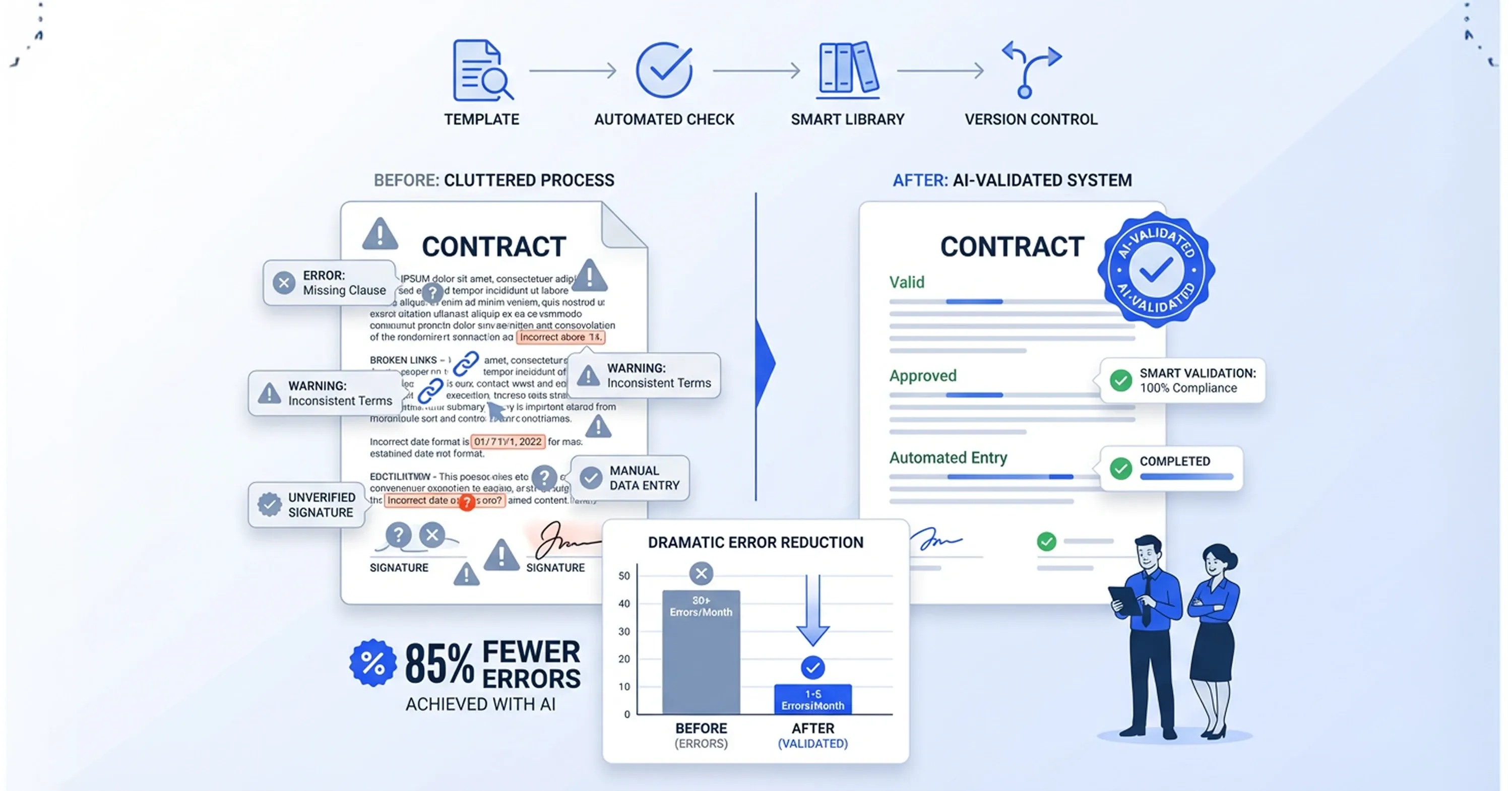
Infographic showing AI contract validation system that automates document checks, reduces errors, and ensures compliance through automated verification and smart workflows.

Speed means nothing if your contracts are full of mistakes. This is where AI adds a layer of intelligence that manual processes simply can't match.

Traditional workflows rely on humans to catch every inconsistency, every outdated clause, every mistyped figure. That's a tall order when your team handles hundreds of agreements each month. AI-powered systems flag anomalies, enforce approved templates, and prevent unauthorized edits before a document ever reaches a signer.

The data backs this up. A 2024 Forrester study found that organizations using advanced contract management saw an 85% reduction in contract errors due to improved contract quality.

  • Template enforcement: AI ensures every contract starts from an approved version, eliminating rogue edits.

  • Auto-validation: Fields are checked against source data, catching mismatches before they become problems.

  • Version control: No more confusion about which draft is current.

  • Clause libraries: Pre-approved language gets suggested automatically based on deal type or jurisdiction.

For operations managers and department leaders, this means fewer fires to put out and less time spent on contract rework. To see how AI can help spot errors and automate contract workflows, check Learn How AI Tools Like ChatGPT Simplify Employment Contract Management. That time goes back into work that actually moves the business forward.

Compliance Without the Constant Worry

If errors are expensive, compliance failures are catastrophic. Fines, voided contracts, damaged reputations: the stakes are high, especially for companies operating across multiple regions.

AI-powered e-signature workflows address compliance on several fronts at once. They maintain complete audit trails, enforce signing order requirements, verify signer identity, and ensure documents meet jurisdiction-specific standards like eIDAS in Europe or ESIGN and UETA in the United States.

How AI Strengthens the Compliance Chain

What makes AI different from basic digital signatures is its ability to learn and adapt. It can flag non-compliant clauses, detect when a document hasn't followed the required approval chain, and alert administrators before something goes out the door.

  • Audit trails: Every action is timestamped and logged, from who opened the document to when they signed.

  • Identity verification: Multi-factor authentication and biometric options ensure the right person signs.

  • Regulatory alignment: AI can apply region-specific rules automatically, reducing the burden on legal teams.

  • Data residency controls: Documents and data stay where regulations require them to be stored.

For growing companies with contracts flowing across borders, this kind of built-in compliance is far more reliable than depending on manual checks. Learn more about robust audit trails and risk management in How do I create a legally binding e-signature?. It's also one of the reasons Agrello has focused on building compliance directly into its digital signature and contract management workflows, giving teams confidence without adding complexity.

Dramatic Cost Savings and ROI

Let's talk about money, because ultimately that's what gets budget approval. AI-powered e-signature workflows don't just save time; they produce measurable financial returns.

The same Forrester study mentioned earlier found that advanced contract lifecycle management delivered a 449% ROI. That figure accounts for reduced labor, fewer errors, faster deal closure, and lower compliance costs.

Here are some specific findings from that research:

  • Time to generate a new sales contract dropped by 90%.

  • Procurement labor costs for researching contract terms fell by 80%.

  • Contract errors declined by 85%, reducing rework and legal exposure.

These aren't theoretical projections. They reflect what composite organizations actually experienced after implementation.

Beyond the direct savings, there's an opportunity-cost argument. When your team spends less time chasing signatures and fixing mistakes, they spend more time closing deals, onboarding talent, and managing vendor relationships. That's where the real value compounds. For practical advice on how to move toward a seamless digital workflow, see AI Agents and the Future of Office Automation: Where Does E-signing Fit?.

The Market Is Moving, and Fast

If you're still evaluating whether this shift is real, the market data should settle it. The e-signature market was estimated at $2.3 to $2.8 billion in 2020 and is projected to exceed $14 billion by 2026, growing at roughly 28 to 30% annually.

This isn't a niche trend. It reflects a broad, cross-industry movement toward intelligent agreement management. And the organizations that invest early are the ones pulling ahead.

Research confirms the competitive edge. Among high-performing organizations, 77% of leaders say effective agreement management helps them outperform their financial goals. Similarly, 55% of organizations with advanced contract-creation capabilities are more likely to exceed financial targets. And 47% of those with advanced routing, editing, and approval workflows report the same advantage.

The pattern is clear: the more intelligent your signing workflows, the stronger your financial performance.

AI-Powered vs. Traditional: A Quick Comparison

Here's a straightforward comparison to make the differences concrete.

  • Contract creation: Traditional takes hours of drafting and editing. AI-powered workflows use templates and auto-populated fields to cut that by up to 90%.

  • Routing and approval: Manual processes depend on email chains and follow-ups. AI routes documents automatically and sends reminders.

  • Error detection: Traditional relies on human review alone. AI flags inconsistencies, missing fields, and non-compliant language.

  • Signing time: Paper contracts take days to weeks. Digital signatures with AI assistance close in minutes to hours.

  • Compliance tracking: Manual audit trails are incomplete at best. AI-powered systems log every action automatically.

  • Cost per contract: Manual handling is labor-intensive. AI-driven workflows reduce labor costs by up to 80%.

For teams managing high volumes, like sales departments processing dozens of contracts per week or HR teams running onboarding at scale, these differences add up fast. For insights on tailoring contract management approaches to your industry, consider From Paperwork to Smart Contracts – How AI and RPA Transform HR Contract Management. Solutions like Agrello aim to make this kind of intelligent workflow accessible without requiring a massive IT overhaul.

Conclusion

AI-powered e-signature workflows do much more than eliminate paper. They create a faster, more accurate, and more scalable way to manage agreements. Instead of relying on slow approvals, manual reviews, and endless follow-ups, businesses can streamline the entire signing process while reducing errors and strengthening compliance.

The value is clear in both day-to-day operations and long-term growth. Faster turnaround times, lower administrative costs, better visibility, and fewer contract mistakes all add up to a stronger, more efficient business process. For teams in sales, HR, procurement, and operations, the advantage goes beyond convenience. It means less time spent chasing signatures and more time focused on work that drives results.

In the end, the real benefit of AI-powered e-signature workflows is not just speed. It is the ability to build a smarter, more reliable agreement process that supports growth without adding unnecessary complexity.

Basic electronic signatures digitize the act of signing but don't add intelligence to the surrounding process. AI-powered workflows go further by automating document routing, populating fields from connected systems, flagging errors and compliance issues, and providing analytics on bottleneck points. The signature itself is just one piece of a much larger, smarter system.

Yes. Digital signatures created through compliant platforms meet legal standards under frameworks like eIDAS in Europe and the ESIGN Act and UETA in the United States. AI-powered features like identity verification and tamper-evident audit trails actually strengthen legal enforceability compared to traditional wet signatures.

Results vary by organization, but independent research has documented returns as high as 449% ROI for companies using advanced contract lifecycle management with AI features. Common savings come from reduced contract generation time, lower error rates, and significant cuts in labor costs for procurement and legal teams.

Implementation timelines range from a few days to several weeks, depending on the complexity of your existing workflows and the integrations you need. Many modern platforms offer out-of-the-box configurations that let teams start signing within hours, with more advanced AI features rolling out as the system learns your patterns.

Yes. Leading platforms include built-in rules for different jurisdictions, automatically applying the right standards based on signer location and document type. This is especially valuable for companies operating internationally, as it removes the burden of manually tracking regulatory requirements in each region.

Schedule a Meeting

Book a time that works best for you and let's discuss your project needs.

You Might Also Like

Discover more insights and articles

Woman reviewing signed documents with text about secure storage and management of e-signed documents, representing digital document security solutions.

What's the Safest Way to Store and Manage Signed Documents?

You just got a contract signed. It's locked in, legally binding, and ready to file away. But where exactly does it go, and who can access it six months from now when someone needs it for an audit? More importantly, will you be able to find the right version quickly, prove its authenticity, and show a clear record of who signed and accessed it?

Man signing a document with illustration of cloud workflow, representing automatic document sending for e-signature and digital signing process.

How Can I Send Documents for E-Signing Automatically?

Every week, your team sends the same contracts, NDAs, and approval forms. Someone downloads a template, fills in the names, attaches it to an email, and waits. Multiply that by dozens of documents, and you've built a bottleneck nobody asked for.

Team reviewing documents with overlay text about verifying if a digital signature is authentic.

How to Verify If a Digital Signature Is Authentic

You just received a signed contract, and now you're staring at a little icon or banner in your PDF reader wondering: is this signature actually real? You're not alone. With the global digital signature market valued at USD 9.85 billion in 2025, more documents than ever carry digital signatures, and knowing how to verify digital signature authenticity has become a daily workplace skill.

Professional man with glasses working on digital documents with text about creating a professional e-signature design.

How to Create a Professional E-Signature Design

Every contract, proposal, and agreement your team sends carries your brand's reputation. When a client opens a document and sees a messy, inconsistent signature block, it quietly chips away at trust before they even read the terms.