Monitoring must expose workflow status
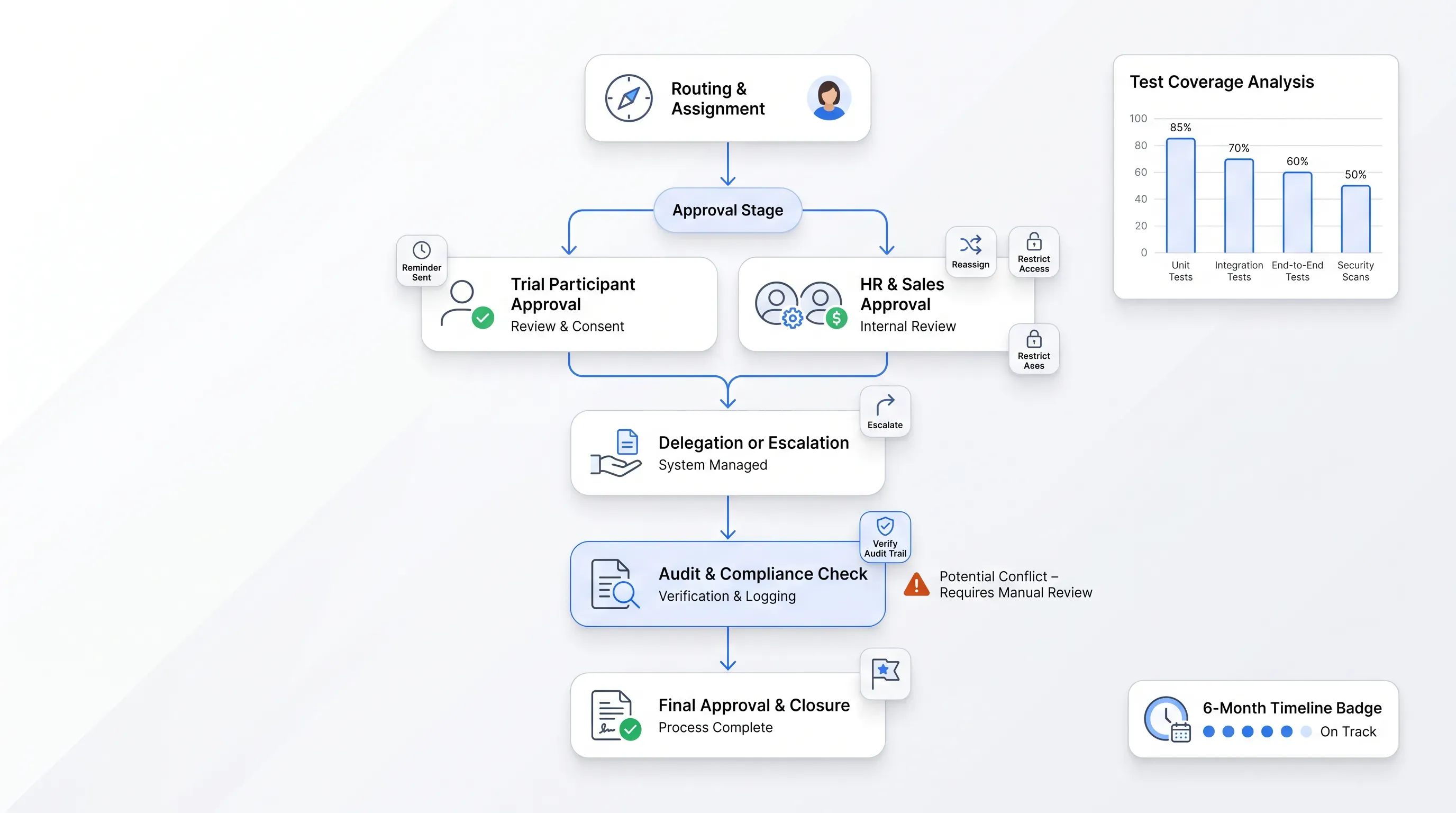
Status visibility means someone can answer "where is this document" in under thirty seconds without asking anyone. That requires a dashboard showing live state and a named owner per pending item.
Five states cover most questions, from waiting to stalled. That last one is the hardest to surface, because nothing has technically failed.
Deloitte's contracting research found that 48% of respondents who invested in their contracting process named better contract data visibility as a key benefit, ahead of other outcomes.
Visibility is what converts a fragmented process into a managed one, and the practical test is uncomfortable but fast. Ask your trial group to name every document currently waiting on an external signer. If they open a spreadsheet or a shared inbox to answer, the platform has added one more place to look.
Exceptions reveal whether automation is resilient
Test the failure paths, because the happy path works in every demo. Six exceptions cover most of what actually happens, from a required field that arrives empty to the Customer Relationship Management (CRM) integration that times out.
What separates resilient software is the recovery path. Can you correct the data and resume from the failed step, or does the whole workflow restart?
PwC's 2026 survey found that 89% of respondents gave at least one reason their technology investments hadn't delivered, with a substantial majority citing two or three reasons.
Multiple simultaneous reasons is the signature of a system that handles normal operation and abandons users at the edges. When a workflow can't recover in-platform, the team finishes the job over email, and that email chain is now the real process. Your audit trail ends where the exception began.
A scorecard makes products comparable
Score each product against one representative HR workflow and one sales workflow, and weight the ten capability areas by what your process actually depends on. Run the same two documents through every shortlisted tool and record the result.
Weight these ten areas and adjust the percentages to your own process:
-
Inputs and data sources (10%) and templates and generation (15%), with routing and approvals at 15%.
-
Validation and controls (10%), signing method and evidence (15%).
-
Status visibility (10%) and exception recovery (10%), with integrations at 5%.
-
Governance and access control (5%), total cost including administration time (5%).
Deloitte's research found that over 50% of organizations have neither carried out nor planned any contract simplification initiative.
Which suggests the scorecard has a second use. If a workflow needs eleven conditional rules to survive the test, the problem is upstream of the software, and no product will score well until the process itself is cut down.
Best fit requires end-to-end evidence
The winning product is the one that completed both test workflows without anyone leaving the platform. Manual effort you can accept and traceability that survives a six-month lookback.
Record specifics as you test. Minutes spent per document and whether the CRM record updated without a manual push.
The integration complexity finding from PwC's survey, cited earlier, is why the integration column deserves real weight even when it looks like plumbing.
A product that scores well on generation and signing but needs a person to copy the signed file into your HRIS has moved the manual step to the end, where it's harder to notice and easier to skip.
Poor fit appears in workflow gaps
Poor fit shows up as work the platform pushes back onto your team. Watch for a spreadsheet reappearing to track status and an exception with no recovery path except starting over.
Any one of these means the workflow is incomplete, regardless of how the feature comparison looked.
Recall the Gartner finding on error rates rising under capacity pressure. Manual gaps are exactly where that pressure lands.
One caveat on your own results. A score measures fit for the two workflows you tested in your systems. A tool that loses your comparison because it can't handle conditional clause logic is the right answer for a company sending one document type at high volume, so keep the scorecard as a record of your scenario.
Could Agrello fit repeatable document workflows?
Agrello is a document management and e-signing platform built for both personal and business use, and it fits teams whose workflows centre on DOCX templates and Excel-driven bulk creation. If your two test workflows are an offer letter pack and a standard sales agreement, that's the shape it's designed for.
Check three things against your own scorecard before you commit:
-
Whether your integrations are covered natively, through Zapier, or through the API, and what that means for maintenance.
-
Which capabilities sit on which plan, since routing and bulk features are frequently plan-dependent.
-
Which signature method applies to your documents, and whether that method meets requirements in the jurisdictions where you operate.
Pricing and automation pages change, so read the current versions. Then do the only test that settles it. Run one real HR document and one real sales document through the platform end to end, and score what you get.