Is the workflow ready for remote signing?
Your workflow is ready when it passes the checks below. Copy the lists below into your evaluation document and mark each item pass, fail, or unresolved. Anything unresolved is a legal or procurement question.
This checklist exists because feature comparison charts answer the wrong question. Only 11% of businesses rate their contract management as very effective, according to figures compiled by Procurement Tactics, which means the gap sits in process ownership rather than software availability. A checklist tied to your own two test contracts closes that gap in a way a vendor matrix can't.
Each subsection below covers one group. Work through them in order, since the identity and evidence checks assume you've already confirmed people can complete the workflow at all.
Signer and workflow checks
Confirm that both an employee and a supplier can reach completion without help from your team. Access comes first, on a mobile browser and without a paid account on the signer's side.
Then verify recipients and roles along with required signing order. Check what completion looks like: who receives the final file, in what format, and whether the signer keeps a copy. Test the exception paths deliberately by letting a document expire and by declining one.
Support matters more than it looks. Concord's data on approval bottlenecks shows delay concentrates where multiple departments touch a document, so ask who the supplier contacts when signing fails at 8pm. If the answer is your operations inbox, you've moved a cost.
Identity and evidence checks
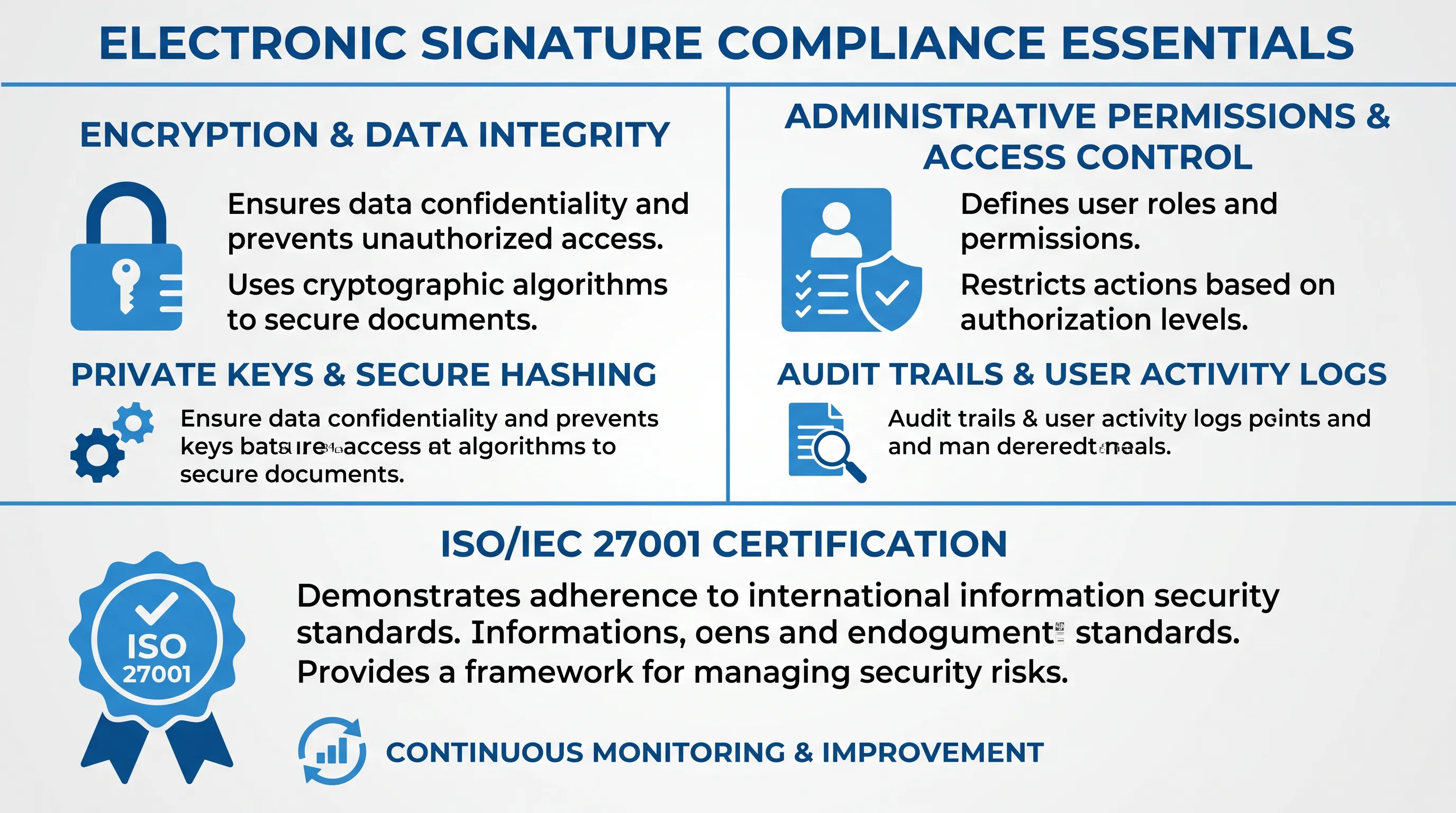
Confirm authentication is proportionate to each document's risk and that intent to sign is captured explicitly, not inferred from a click somewhere on the page.
Then check the evidence itself. Signeasy's summary of the ESIGN requirements lists intent to sign alongside consent and record retention as the core obligations, which means intent is a compliance item.
Work through the rest in this order:
-
Audit record naming every recipient, action, and timestamp, exportable on demand
-
Document integrity proof that survives certificate expiry
-
Geographic validity confirmed per signer country and document type
-
Retention period, retrieval rights, export format, and deletion procedure in writing
One inference worth drawing: if intent is a legal requirement, then a signing page where the confirmation button is ambiguous creates legal exposure regardless of how strong the authentication behind it was.
Pilot and evaluation checks
Run your two representative contracts end to end with real signers. A pilot with cooperative internal testers tells you almost nothing about a supplier in a different time zone.
Measure completion rate and time to completion during the pilot. Then inspect the exported evidence file yourself and verify plan limits, because Certinal's review of pricing models documents complaints that advertised annual plans were in practice capped at 100 envelopes, after which another payment was required.
That pricing pattern has an evaluation consequence most teams miss. If your plan meters envelopes, then reminders and re-sends consume budget, which quietly discourages the exact behavior that raises completion rates. Confirm what counts as a billable send before you commit, and route any jurisdiction or formality question to legal while the pilot is still running.
When is remote signing the best fit?
Remote signing fits best where contracts repeat and signers are reachable digitally. Employment agreements and supplier terms qualify because the document is standard and the approval path is stable.
It fits poorly in the opposite conditions. Signers without reliable devices or connectivity will stall. Documents requiring physical witnessing or notarization will fail regardless of vendor quality. The World Economic Forum's survey of national approaches notes that countries including Brazil, Chile, China, India, Mexico, and South Africa recognize simple electronic signatures but reserve equivalence to handwritten signatures for digital signatures specifically.
That distinction has a practical edge for a distributed team. A single platform can serve your Estonian and German suppliers under one signature method while your Indian supplier needs another, so the useful question is which document types you can standardize and which ones stay exceptions handled by hand.
Could Agrello support your workflow?
Agrello is a document management and e-signing platform built in Estonia, and it supports the specific mechanics this evaluation tests: named recipients with defined roles and audit evidence attached to completed documents. Signing works through national e-ID or Agrello's own advanced electronic signature.
Its Microsoft Word add-in lets you set signers and signing order from inside Word and export completed files as ASiC, eDoc, or PDF, with GDPR and eIDAS compliance stated for the integration. Software Advice lists pricing from €19.90 per user per month at the time of writing.
Two dependencies to confirm directly before you adopt. Available signature methods vary by signer country, since national e-ID coverage isn't universal, and features including signing order and evidence export depend on your plan tier. Check the current signatures and pricing pages, then run the two-contract pilot described above with one employee and one supplier.