What You'll Learn in This Guide
This article walks you through the practical mechanics of how AI handles contract reminders and renewals, step by step. You'll see how artificial intelligence extracts key dates from agreements, builds automated reminder sequences, routes notifications to the right people, and reduces the operational risk that comes with manual tracking. Whether you manage five contracts or five hundred, the workflow is the same. By the end, you'll have a clear picture of how contract lifecycle automation replaces fragile manual processes with something reliable.
Let AI Extract Key Dates and Terms from Your Contracts
Before any reminder can fire, the system needs to know what it's working with. This is where AI earns its keep fastest.
Traditional contract management means someone manually opening each PDF or Word file, hunting for renewal dates, notice periods, and termination windows, then copying those dates into a calendar or tracker. That process alone takes 15 to 30 minutes per contract when done by hand. In practice, the problem compounds quickly. A team managing 200 active contracts spends the equivalent of two full workweeks per year just on manual date logging - before a single negotiation begins.
AI-powered extraction flips that timeline. Natural language processing (NLP) scans your contract documents and pulls out the critical fields automatically:
-
Renewal dates and expiration dates
-
Notice period windows (e.g., "60 days before expiration")
-
Auto-renewal clauses and opt-out deadlines
-
Payment milestones tied to contract phases
-
Parties responsible for initiating renewal discussions
The speed difference is dramatic. AI date extraction from standard contracts runs in seconds, and contract data extraction achieves an 80 to 90% reduction in processing time compared to manual review. Instead of half an hour per agreement, you're looking at two to three minutes of human review to confirm what the AI found.
If you're seeking a deeper practical view on how AI can automate contract data extraction and minimize manual intervention, see How can AI streamline contract management for SMBs?.
Handling Non-Standard or Complex Agreements
Not every contract follows a clean template. Some have nested renewal conditions, multi-year escalation clauses, or amendments that override the original terms. Modern AI models handle these by cross-referencing amendment documents against master agreements, flagging conflicts for human review rather than guessing.This matters more than it sounds. In one common scenario, an amendment extending a notice period from 30 to 60 days sits in a separate file from the master agreement. A manual reviewer might miss it. An AI cross-referencing both documents catches the discrepancy and flags it - preventing a team from acting on outdated terms.
The key takeaway here: extraction is the foundation. Without accurate date capture, every downstream reminder is unreliable. Getting this step right makes everything else work.
Build Tiered Reminder Sequences That Match Your Workflow
Once AI knows your contract dates, the next job is turning those dates into action. This is where static calendar reminders fall short and intelligent sequencing takes over.
A single "reminder 30 days before" notification isn't enough for most agreements. Different contracts require different lead times. A major vendor renewal might need internal discussion four months out, while a simple software subscription only needs a two-week heads-up.
AI-powered systems let you configure tiered reminder sequences based on contract value, complexity, or category. For example, some platforms set reminders at 120, 90, 60, and 30-day intervals before key dates, while others go more granular with 90, 60, 30, 14, and 7-day notification schedules.
Here's what a practical tiered setup looks like for a high-value vendor contract:
-
120 days out: Notify the department manager that a renewal review period is opening
-
90 days out: Alert procurement and finance to begin cost analysis
-
60 days out: Flag the contract owner to initiate vendor discussions
-
30 days out: Escalate to leadership if no action has been taken
-
14 days out: Final warning with auto-escalation to a backup approver
Customizing Reminders by Contract Type
Not every agreement warrants five reminders. AI categorizes contracts by type, value, or risk level and applies the appropriate reminder cadence automatically. Low-risk, low-value agreements might only trigger two notifications, while anything above a certain dollar threshold gets the full sequence.
This layered approach is what separates contract lifecycle automation from basic calendar alerts. You're not just reminding people; you're building a workflow that adapts to the importance of each agreement.
Route Notifications to the Right People Automatically
Sending a reminder is only useful if it reaches someone who can act on it. In many organizations, contract ownership is fuzzy. The person who signed the agreement two years ago may have changed roles or left entirely.
AI solves this by mapping contract ownership to current organizational data, then routing notifications through the right channels: email, Slack, Teams, or whatever your team actually uses.
-
Primary owner gets the first notification
-
Backup contacts receive alerts if the primary doesn't respond within a set window
-
Managers or executives get escalation notices when deadlines approach without action
-
Cross-functional stakeholders (legal, finance, procurement) are looped in based on contract type
If you'd like a closer look at how modern platforms use AI to automate routing and minimize delays, the guide on How Can I Send Documents for E-Signing Automatically? provides practical insights.
The efficiency gain here is significant. Stakeholder notification and follow-up sees a 70 to 80% reduction in time when AI handles routing and escalation compared to someone manually checking in via email chains.
Platforms like Agrello make this particularly smooth by combining contract storage, digital signature capabilities, and automated workflows in one place, so the person receiving a renewal reminder can review, negotiate, and re-sign without jumping between tools.
Reliable routing eliminates the "I thought someone else was handling it" problem that causes most missed renewals.
Automate the Renewal Decision Workflow
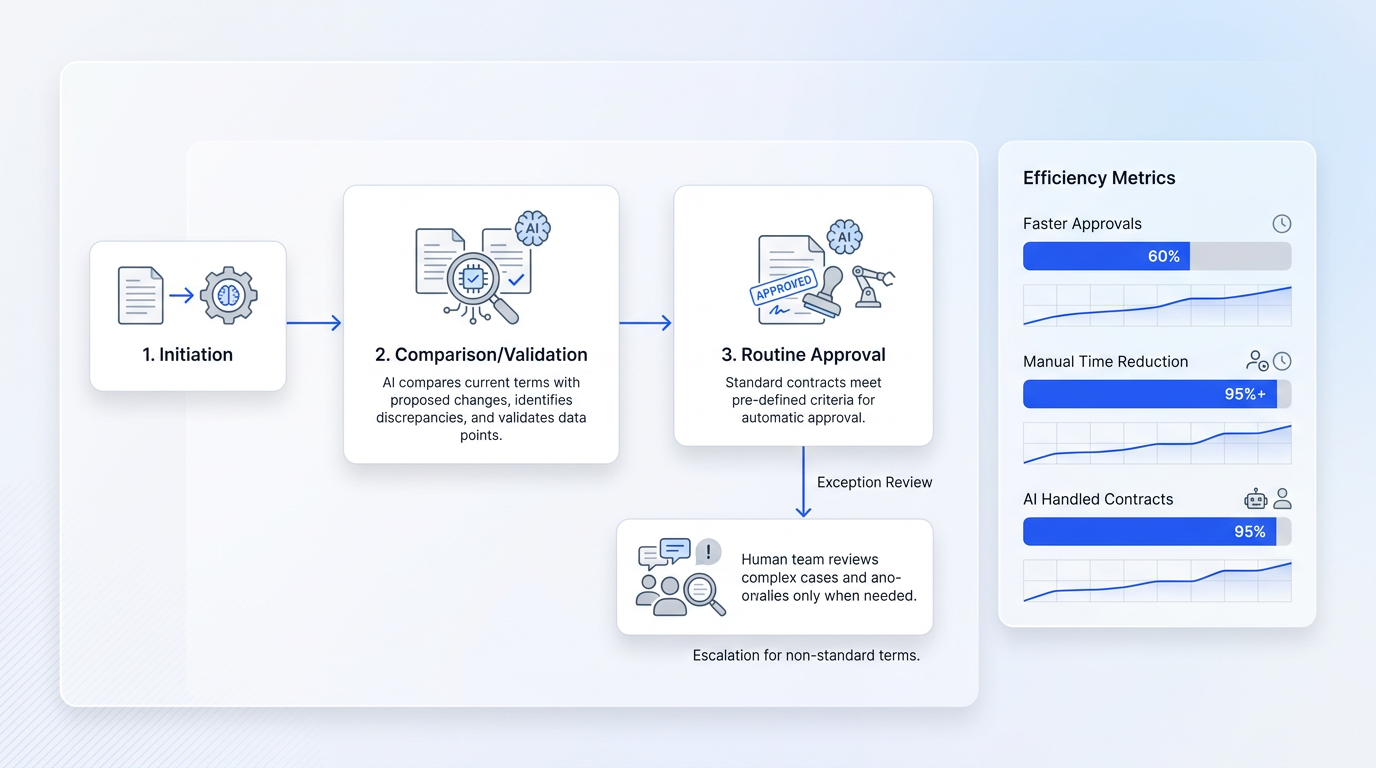
Reminders get attention. But AI can go further by automating the decision process itself.
When a renewal window opens, the system can automatically:
-
Pull the current contract terms and any amendments into a review dashboard
-
Compare pricing against market benchmarks or internal budget thresholds
-
Flag contracts where terms have changed or costs have increased beyond a set percentage
-
Pre-populate renewal documents for contracts that meet auto-approval criteria
-
Route complex renewals through an approval chain with 60% faster approvals thanks to automated routing
To learn more about building approval chains with AI - including conditional routing based on contract value and managing exceptions - you may find How can AI help me automate document signing? helpful.
When to Keep Humans in the Loop
Full automation works well for straightforward renewals: same terms, same price, same vendor. But contracts involving renegotiation, significant spend, or strategic partnerships benefit from human judgment. The best approach is a hybrid model where AI handles the routine 95% and flags the exceptions for your team to review.
This is where reminder management sees a 95%+ reduction in manual time compared to calendar-based tracking. The AI does the heavy lifting; your team makes the calls that actually require thinking.
Track Everything and Reduce Risk Over Time
The final step isn't really a step at all. It's what happens continuously once AI is managing your contract reminders and renewals.
Every action, notification, response, and decision gets logged automatically. This creates an audit trail that's useful for compliance, dispute resolution, and internal reporting.
For a step-by-step guide on ensuring secure audit trails, compliance, and best practices around storing signed contracts, see What's the Safest Way to Store and Manage Signed Documents?.
Over time, the system generates insights you'd never get from manual tracking:
-
Which contracts consistently require last-minute scrambles
-
Which departments are slowest to respond to renewal reminders
-
Where auto-renewal clauses are costing you money because no one reviewed terms
-
How total administrative time on renewals drops by 30 to 60% after implementation
These patterns help you refine your contract lifecycle automation strategy. Maybe certain vendor categories need longer lead times. Maybe a specific team needs earlier notifications. The data tells you exactly where to adjust.
With tools like Agrello, this visibility extends to the signing process itself, connecting renewal tracking with digital signature workflows so you can see the full picture from reminder to executed agreement.
AI contract reminder automation is the process of using artificial intelligence to extract key dates from agreements, generate tiered notification sequences, route alerts to responsible stakeholders, and track renewal actions, replacing manual calendar management with a system that reduces missed deadlines and operational risk.
Conclusion
Missed contract deadlines aren't a process problem - they're a visibility problem. When critical dates live in scattered spreadsheets and someone's inbox, the question isn't whether something will slip. It's when. AI solves this at the root. It extracts dates before anyone has to hunt for them, fires reminders before anyone has to remember, routes alerts before anyone has to ask who's responsible, and logs every action before anyone has to reconstruct what happened.
The operational result is a renewal process that runs in the background without friction - one that doesn't depend on the right person checking the right calendar on the right day. Your team stops chasing deadlines and starts making decisions that actually require their judgment.
Start with extraction. Layer in tiered reminders. Let the system handle the follow-through. The contracts that used to slip through the cracks become the ones you never have to think about.