Title:
What are real-world examples of digital signatures?

Meta description:
Curious about What are real-world examples of digital signatures? See how online contracts save you time and protect your

What are real-world examples of digital signatures?

Real-world digital signatures are the documents your business already signs online. HR uses them for offer letters and employment contracts. Legal teams use them for non-disclosure and vendor agreements. Finance teams use them for loan and account-opening forms. Healthcare teams use them for patient consent forms. Governments use them for tax filings and business registrations, and individuals sign leases and enrollment forms the same way.

Content authorBy Toomas PihlPublished onReading time11 min read

What counts as a digital signature example?

A digital signature example is any real document a person or business signs electronically in a way that is legally binding and verifiable. That covers a six-figure loan agreement and a routine policy acknowledgment with equal validity, because the law cares about intent and a tamper-proof record.

The scope is wide on purpose. Across industries, somewhere between 60% and 80% of organizations have already adopted some level of e-signature technology, according to a 2025 Certinal analysis, and 95% are either using it or planning to. So the practical question is no longer whether your documents qualify. It's which of your recurring forms move first.

That adoption number shows the report's unstated point: paper now sits outside the normal workflow in most offices. If you're still printing and scanning, you're working against the grain of how your suppliers and banks already expect to sign. Your new hires expect the same. The rest of this article is organized by industry and document type so you can spot your own paperwork.

What are digital signature examples in legal work?

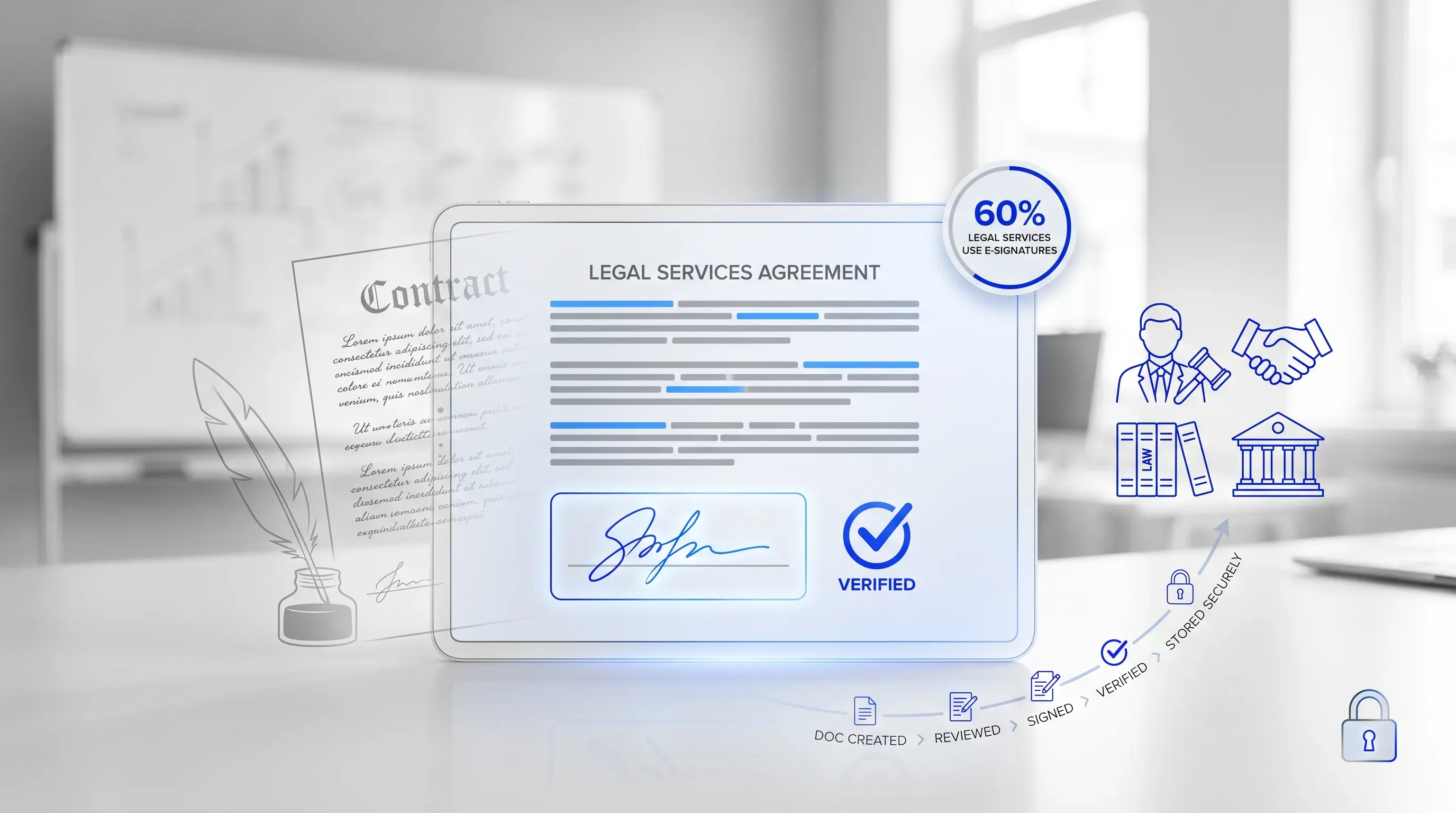
A softly lit office scene with a digital tablet displaying a legal document, surrounded by icons and a blurred professional background.

Legal work signs contracts and non-disclosure agreements digitally as a matter of routine. Partnership agreements and court filings follow the same path, as do procurement documents. Legal teams were early adopters because every signature in their world needs a verifiable audit trail and a record that can prove the document wasn't altered after the fact.

That requirement is exactly what an electronic signature delivers. The system stamps who signed, when, and from where, then locks the file so any later change is detectable. Roughly 60% of legal services have adopted e-signatures for contracts and filings, per the same Certinal data, which puts the legal sector ahead of plenty of industries that move faster in other respects.

Here's the part worth sitting with. A signed paper contract in a filing cabinet proves only that two names appear on a page. A properly signed digital contract proves who signed and when, then preserves every clause in one record. For a business that occasionally ends up in a dispute over what was actually agreed, that's a stronger position than wet ink ever gave you.

Which contracts get signed electronically?

Sales agreements and service contracts are the everyday business contracts that move to e-signing first. NDAs and vendor agreements follow the same path. These are repeatable, high-volume documents where speed directly affects revenue, so the time saved compounds fast.

The numbers back the urgency. When agreements are sent through an e-signature platform, 79% are signed within 24 hours, compared with the days or weeks paper routinely takes. That's a 15-day faster turnaround on average across the documents studied.

What that means for a sales coordinator chasing signatures at quarter-end is concrete. A contract that closes the same afternoon instead of the following week pulls revenue into the current period and frees you from the follow-up calls. The bottleneck stops being the customer's decision and becomes only how quickly you hit send.

Why do law firms trust e-signatures?

A compliant electronic signature carries the same legal weight as a wet-ink signature, which is the foundation of the trust. It's backed by an unalterable audit trail that records who signed, the exact time, and confirmation that nobody changed the document afterward.

The legal grounding is specific. Under the EU's eIDAS regulation, a qualified electronic signature has the equivalent legal effect of a handwritten signature across all member states, a point the European Commission spells out in its eSignature guidance.

The quiet advantage here is evidence. A wet signature can be disputed as forged, and proving otherwise means handwriting experts and time. A signed digital record already carries the proof inside it, which is why a firm that lives and dies by enforceability would rather hold the digital version.

Cut contract signing time by 60%

See how Agrello can automate your contract workflows from creation to e-signature in one free consultation.

How does HR use digital signatures?

HR signs offer letters and employment contracts digitally. Onboarding paperwork and NDAs move the same way. Benefits enrollment forms and policy acknowledgments do too. HR is one of the highest-volume, most repetitive signing functions in any company, which is precisely why it sees the largest time savings when the paperwork moves online.

The gain shows up in hours. One analysis found that onboarding software cut HR's active involvement per new hire from 10 hours down to about 2 hours, which saves roughly 8 hours for every employee brought on. Electronic signatures are a core part of that, because a new hire enters their information once and it populates every form automatically.

If you run hiring at a growing company, do the multiplication yourself. Eight hours saved per hire across forty hires a year is a full working month of staff time returned to actual people work. That's the case to make when someone above you asks why the switch is worth paying for, and it holds up better than any vague promise of efficiency.

What are digital signature examples in finance?

Finance signs loan agreements and account-opening forms electronically. Customer onboarding and Know Your Customer (KYC) paperwork move through the same process, as do insurance policies and invoices. The difference here is identity. Finance demands stronger verification because the signer's identity has to be proven beyond doubt before money or risk changes hands.

That extra rigor pays for itself. Research by Namirial found that automating and standardizing KYC through qualified electronic signatures can reduce related operational costs by 40 to 60%, according to Deloitte's analysis of eIDAS in financial services.

For a business that opens accounts or signs financing with banks and customers, the lesson runs deeper than cost. Identity-checked signing collapses an onboarding process that once needed appointments and days of manual verification into minutes, without loosening the compliance you're legally bound to. You move faster and your auditor is happier at the same time, which is a combination finance rarely gets to enjoy.

How is healthcare using digital signatures?

Healthcare signs patient consent forms and treatment authorizations digitally. Prescriptions and provider agreements move the same way. The technology does two jobs at once: it speeds up admissions and keeps a secure, access-logged record of sensitive data so every view and change is traceable.

Estonia's national e-health system is the clearest working example. Every medical document in the system is digitally signed, and the platform now holds over 40 million health documents with 99% of all prescriptions issued digitally, per e-Estonia's figures. Verified identity controls who can open each record, and the access trail can't be removed.

The insight Estonia's setup quietly proves is that security and speed aren't a trade-off in healthcare, the way people assume. The same signature that lets a doctor authorize treatment in seconds also creates the tamper-proof log that protects the patient's privacy. You get the fast admission and the audit record from one action.

Cut contract signing time by 60%

See how Agrello can automate your contract workflows from creation to e-signature in one free consultation.

Where else do people sign digitally every day?

Government services and real estate run on digital signatures, well beyond the four core business industries. Education and personal agreements do too. People sign tax filings and business registrations this way without thinking of it as anything unusual. They also sign lease agreements and school enrollment forms this way without thinking of it as anything unusual.

Real estate makes the point plainly. Over 65% of property transactions now use e-signatures, according to Certinal's 2025 figures, which means the lease or purchase you sign at home is already the standard transaction.

Why this matters for your office is recognition. The same signing you do on a Saturday for an apartment lease is the signing your operations team can apply to vendor contracts on Monday. There's no separate learning curve and no special category of trust to build, because the practice is already woven into ordinary life. That familiarity is half the reason adoption inside companies moves as quickly as it does.

How do governments use digital signatures?

Governments sign tax filings and business registry submissions with a national electronic ID (e-ID). Permit applications and benefits registrations use the same route. Citizens authenticate themselves with a state-issued identity, then sign the document online with full legal force.

Estonia is the country where this model is standard. 100% of tax declarations are filed online there, and it takes about three minutes, per the official e-Estonia guide. Businesses are established online 98% of the time.

The takeaway for a private business is that the hard part has already been solved at national scale. If an entire country can run its tax system and company registry on signed digital identity, the objection that your contracts are somehow too sensitive to sign this way doesn't hold. The trust model has been stress-tested by a government for two decades.

Can two strangers sign one document remotely?

Yes. Verified digital identity lets two parties who have never met sign the same legally binding document from different locations without sharing the same room. That capability is what makes remote deals and cross-border agreements possible at all.

Estonia's e-ID is built for exactly this. Secure digital signatures there are legally equivalent to a handwritten signature and face-to-face identification, and between partners by agreement, anywhere in the world, per e-Estonia.

The practical consequence is that geography stops limiting who you can close with. A supplier three countries away signs the same enforceable contract as one across town, identity confirmed on both ends. For a growing company chasing deals outside its own city, that removes the single biggest reason paper used to force people onto planes.

Which signature type fits which document?

Match the signature strength to the document's risk. Simple electronic signatures suit low-risk internal approvals. Advanced signatures suit most business contracts, while qualified signatures suit high-stakes or legally mandated documents. You don't need to understand the cryptography underneath to make the right call, only the stakes of the paper in front of you.

Here's the practical mapping:

  • Simple electronic signature: internal sign-offs and policy acknowledgments where the risk of dispute is low; routine approvals fit here too.

  • Advanced electronic signature: sales contracts and vendor agreements where you need verified identity and tamper detection; NDAs and most commercial paperwork fit here too.

  • Qualified electronic signature: documents the law specifically requires it for, plus the highest-value or most contested agreements.

The legal line behind this is worth knowing. Under eIDAS, only a qualified electronic signature explicitly holds the equivalent legal effect of a handwritten signature across the EU, as GlobalSign explains, while simple and advanced signatures still carry real evidentiary weight.

What that means in practice is that over-engineering wastes effort. Putting a qualified signature on an internal leave approval is like notarizing a sticky note. Reserve the heavier identity checks for the documents whose failure would actually cost you, and let the routine stuff move fast.

How can your business start signing digitally?

Start by listing the documents you already recognized in the sections above, then pick a platform that handles all of them in one place. The natural next step after seeing your own offer letters and vendor contracts in the examples is to stop printing them. The same applies to onboarding forms.

Agrello is an Estonian e-signing and contract-management platform built for small and mid-sized businesses. It lets you create legally binding documents online. Its workflows automate bulk generation and signing through national e-ID or its own advanced electronic signature, even between parties who have never met. The platform stores the files securely. It covers the same legal and HR documents this article walked through, along with finance and contract documents.

The concrete payoff is time. Agrello reports cutting signing time by up to 60%, which is the difference that matters most when you're the person handling high volumes of paperwork every week. Map your recurring documents to the right signature type and move the highest-volume ones first. Then measure the turnaround you get back.
Cut contract signing time by 60%

See how Agrello can automate your contract workflows from creation to e-signature in one free consultation.

No, a scanned handwritten signature isn’t the same as a digital signature. A scan is only an image of a signature, while a digital signature includes verification data and tamper evidence. A scanned signature can show intent, but it gives weaker proof if the document is disputed.

A digital signature is proven through the signed file and its audit trail. Keep them together. The record should identify the signer and show the signing time. It should also flag changes after signing, because that evidence supports enforceability if the agreement is challenged.

Yes, you can sign multiple documents at once if the process shows exactly which files are included and records your intent for each one. A copied signature image across a packet is weaker because it doesn’t create a separate audit record for every document.

Avoid using a digital signature when a law, regulator, or court rule requires a paper original or a specific notarized process. The safe step is to check the rule for that document type before signing. This matters most for filings, inheritance documents, and regulated transactions.

Keep digitally signed documents for the same retention period that applies to the paper version. Store the audit trail with the signed file, since separating them weakens your evidence. Retention periods depend on document type and jurisdiction, so set schedules for HR records and tax records separately.

Schedule a Meeting

Book a time that works best for you and let's discuss your project needs.

You Might Also Like

Discover more insights and articles

Title:
What Is eSignature Software and Why Businesses Are Switching

Meta description:
Learn how esignature software works so you can replace manual paperwork and sign documents faster.

Article:
# Wh

What Is eSignature Software and Why Businesses Are Switching

This article explains what eSignature software is and why a growing number of mid-sized companies are dropping the print-scan-mail routine. You'll learn how legally sound eSignature technology works and how to tell if your team is ready to make the switch.

Title:
How can digital signatures reduce office admin time?

Meta description:
Learn how can digital signatures reduce office admin time? You reclaim a full work week each year when you move your docu

How can digital signatures reduce office admin time?

Digital signatures cut document signing and handling time by up to around 60 percent because they remove the manual steps wrapped around the signature itself, from printing to filing. The surrounding admin is the slow part, and those hours disappear when the whole process moves online.

Title:
Digital Signature Software: A Complete Guide for Businesses

Meta description:
Choose digital signature software that fits your workflow, so you sign faster and protect business documents.

Art

Digital Signature Software: A Complete Guide for Businesses

This article explains what digital signature software is and how it works for secure document signing. It walks through the features that matter and the compliance and security standards worth checking, then gives you a simple way to choose a tool that fits how your business already runs.

Title:
Best E-Signature Software for Fast Contract Signing in 2026

Meta description:
Compare e signature software options to find the right tool for your workflow so you can sign agreements faster.

Best E-Signature Software for Fast Contract Signing in 2026

This article compares the e signature software options that businesses are using in 2026 to close contracts faster. You'll see side-by-side breakdowns of the leading platforms and the features that actually shave days off turnaround, with clear recommendations by team function.