Title:
What Is eSignature Software and Why Businesses Are Switching

Meta description:
Learn how esignature software works so you can replace manual paperwork and sign documents faster.

Article:
# Wh

What Is eSignature Software and Why Businesses Are Switching

This article explains what eSignature software is and why a growing number of mid-sized companies are dropping the print-scan-mail routine. You'll learn how legally sound eSignature technology works and how to tell if your team is ready to make the switch.

Content authorBy Toomas PihlPublished onReading time9 min read

Why paper signatures slow teams down

You know the routine because you live it. A contract needs a signature, so someone prints it and emails the scanned file to the next person who has to do the same thing. With eSignature software, that whole loop disappears, but most teams keep running the old way out of habit. And every step in that loop costs a day or two.

The wait is where the real damage happens. A sales agreement sits in an inbox while a client looks for a printer. A new hire's paperwork stalls before their first day because one form went unsigned. Onboarding slips, and deals cool off while the person chasing the document spends their week on the same polite reminder.

None of this is anyone's fault. The process itself is the problem, and it gets worse as a company grows from a handful of contracts a month to dozens. At a certain volume, paper signing stops being a minor annoyance and starts costing real time and revenue. That's the point where a dedicated category of tool earns its place.

What eSignature software is

eSignature software is a tool that lets people sign documents digitally and legally without ever touching a printer. You upload a document, mark where signatures go, and the system handles the rest. The completed file comes back signed and stored with the date, ready to pull up whenever you need it.

The flow is simple enough to explain in a sentence. You upload a contract, invite signers by email, and each person signs from a phone or laptop wherever they happen to be. The finished file is saved with a record of who signed and exactly when.

Here's the part worth getting right. A true eSignature platform is not the same as typing your name into a document or pasting a picture of your handwritten signature. The European Commission defines an electronic signature as data attached to other data that the signatory uses to sign, and a real platform builds an audit record around that act. A pasted image proves nothing about who added it or when. The platform captures the identity and the timestamp, which is what turns a signature into evidence.

eSignature Software vs Digital Signatures
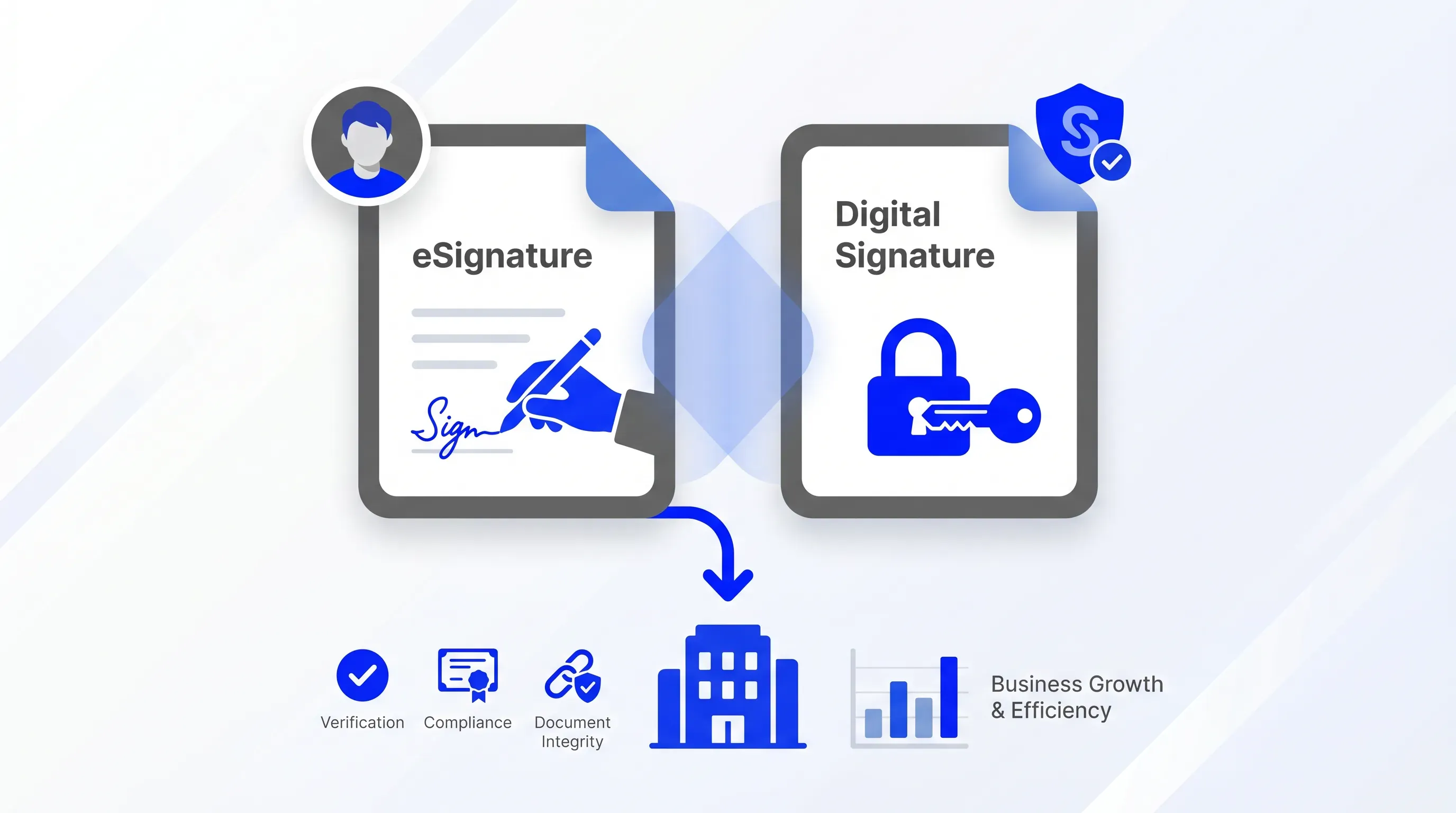
A flat design illustration comparing eSignatures and digital signatures, featuring document icons, a business building, and verification icons.

Many people use the terms eSignature and digital signature interchangeably, but they are not exactly the same.

An electronic signature (eSignature) is the act of signing a document electronically. It can be as simple as clicking a signature field, drawing a signature, or typing your name.

A digital signature is the technology that helps verify the identity of the signer and protects the document from tampering. It uses cryptographic methods to provide additional security and authenticity.

In practice, modern eSignature software often combines both. Users enjoy a simple signing experience, while the platform creates the security and verification layers needed for compliance and trust.

This distinction matters for businesses that need legally valid agreements, audit trails, and proof that documents have not been altered after signing.
Cut contract signing time by 60%

See how Agrello can automate your contract workflows from creation to e-signature in one free consultation.

Key benefits of eSignature software

Strip away the feature lists and the value of eSignature software comes down to three things that matter at your company's size. It's simpler for everyone who has to sign. It holds up legally. And it automates the busywork that one person on your team is doing by hand right now.

Simpler signing for everyone

The print-scan-mail loop is gone. Someone opens a link, signs on their phone, and they're done in a minute. No printer, and no app to download before they can finish.

That simplicity matters more than it sounds, because the people signing your documents are not all on your team. People outside your team have to sign too, and you can't train them. If signing takes more than a minute or asks them to create an account, some of them stall, and you're back to chasing. The fewer steps between sending and signed, the faster the document comes back.

Faster turnaround shortens everything downstream. A deal that took a week of back-and-forth closes in an afternoon. A new hire signs the offer the same day instead of waiting on the mail. When the demand for office signing spiked during the 2020 lockdowns, the EU's own signing service saw end-user volume jump 260 percent in three months, because the moment people couldn't reach a printer, the speed of digital signing became obvious.

Built-in legal compliance

The worry that stops most teams is whether a digital signature actually counts. It does, and it has for over two decades. In the US, the Electronic Signatures in Global and National Commerce Act was signed into law in 2000 and gave electronic contracts the same legal weight as paper ones. Most states also adopted the Uniform Electronic Transactions Act (UETA), which does the same at the state level.

Europe runs on a parallel framework. Since 1 July 2016, electronic signatures across the EU have been governed by the eIDAS Regulation, which gives them legal certainty for cross-border use between businesses and citizens. The regulation sets a clear principle that a court can't throw out a signature as evidence only because it's electronic.

What protects you if an agreement is ever questioned is the record the software keeps. A reputable eSignature platform builds a digital audit trail for each document, and a 2017 European Commission paper called that trail the most significant advantage from a legal perspective. The record shows who signed and exactly when, with proof that the document wasn't altered afterward. Switching to digital gives you a stronger paper trail than paper ever did.

Cut contract signing time by 60%

See how Agrello can automate your contract workflows from creation to e-signature in one free consultation.

Automation that saves time

Right now, one person on your team is probably the human glue holding signing together. They manage the document from the first send to the next signer, then handle the reminders until the finished copy is filed somewhere it can be found later. eSignature software takes that whole job off their plate.

The automation covers the steps that eat the most time:

  • Reminders go out on their own, so nobody has to write the third follow-up email.

  • Documents route to multiple signers in the right order, one after another, without manual handoffs.

  • Reusable templates mean a standard contract gets prepared in seconds instead of being rebuilt each time.

  • Completed files are stored automatically, so nothing gets lost in someone's downloads folder.

This is what makes the tool scale with you. When your volume doubles, manual chasing doubles the workload on whoever owns it. Automated routing handles ten documents or a hundred with the same effort, which is exactly the relief a growing team needs.

Why mid-sized businesses are switching

There's a specific tipping point that pushes companies of roughly 50 to 500 people to adopt this category, and it's worth naming. Your document volume has outgrown manual signing, but you don't have the budget or the appetite to hire someone just to manage paperwork. You're stuck between a process that no longer fits and a headcount solution that makes no sense.

The money is following that pressure. The global e-signature market reached USD 3.2 billion in 2024 and is forecast to grow at a 26.7% compound annual rate through 2030. Adoption in the US is already wide, with Fortune Business Insights reporting that roughly 70 to 80 percent of US organizations have folded e-signature tools into their operations.

The other driver is what your customers and competitors now expect. When a prospect can sign with a competitor in an afternoon, asking them to print and scan makes you look slow before the relationship even starts. Faster closing and faster onboarding have become part of the experience people judge you on, and the company that signs in minutes wins the comparison.

How to know if your team is ready

Not every team needs this yet, and it's fair to say so. The honest test is whether signing has become a recurring bottleneck or whether it's still a minor task you handle a few times a month. If your volume is low, the switch can wait without costing you anything.

Here are the signals that point the other way:

  • Deals or onboarding regularly stall while you wait on a signature.

  • Your contract volume has climbed to the point where one person spends real hours chasing documents.

  • Your signers are remote or spread across locations, so passing paper around isn't practical.

  • You have compliance or record-keeping requirements that a clean audit trail satisfies.

If two or more of those describe your week, the math already favors a tool. The cost of the software is small next to the hours your team spends managing signatures by hand, and the friction you're removing shows up immediately in faster turnaround.

Making the switch

You now know what eSignature software is and how it holds up legally while it removes the manual work that slows your team down. The category exists because paper signing breaks at exactly the size your company has reached.

The smart way in is small. Pick one high-volume workflow, your sales agreements or your new-hire paperwork, and run it through a tool for a few weeks before rolling anything out company-wide. The move is low-risk and reversible at the start, so you're testing a real workflow with little to lose. If you want a platform built around legally valid signing and a clean audit trail, Agrello is a straightforward place to evaluate what eSignature software can do for your team.

Cut contract signing time by 60%

See how Agrello can automate your contract workflows from creation to e-signature in one free consultation.

No, you can’t use eSignatures for every document. Laws can exclude records such as wills, codicils, testamentary trusts, and certain court filings, depending on the country or state. Before moving a document type online, check the rules that apply to that transaction and your signer’s location.

Start with a workflow that has steady volume and low legal complexity. Sales agreements, HR offer letters, policy acknowledgments, and supplier forms are common starting points because they repeat often and follow a predictable format. Track turnaround time before and after the test so you can see whether the change saves work.

Keep the signed document, the audit trail, signer details, timestamps, and any completion certificate your platform provides. Store them in a shared system with clear access rules. This matters because a signed file alone tells less than a file linked to proof of consent, identity steps, and document history.

External signers shouldn’t need an account for a basic signing flow. A good setup lets them open a secure link, review the file, and sign from a browser. If your process forces every client or candidate to register first, completion rates can drop because the signer has extra work before they reach the document.

Templates reduce errors by locking in the fields, signer roles, and signing order for repeat documents. In esignature software, this means a coordinator doesn’t rebuild the same contract each time. Agrello, for example, fits this type of workflow when teams need legally valid signing with a clear audit trail.

Schedule a Meeting

Book a time that works best for you and let's discuss your project needs.

You Might Also Like

Discover more insights and articles

Title:
How can digital signatures reduce office admin time?

Meta description:
Learn how can digital signatures reduce office admin time? You reclaim a full work week each year when you move your docu

How can digital signatures reduce office admin time?

Digital signatures cut document signing and handling time by up to around 60 percent because they remove the manual steps wrapped around the signature itself, from printing to filing. The surrounding admin is the slow part, and those hours disappear when the whole process moves online.

Title:
Digital Signature Software: A Complete Guide for Businesses

Meta description:
Choose digital signature software that fits your workflow, so you sign faster and protect business documents.

Art

Digital Signature Software: A Complete Guide for Businesses

This article explains what digital signature software is and how it works for secure document signing. It walks through the features that matter and the compliance and security standards worth checking, then gives you a simple way to choose a tool that fits how your business already runs.

Title:
Best E-Signature Software for Fast Contract Signing in 2026

Meta description:
Compare e signature software options to find the right tool for your workflow so you can sign agreements faster.

Best E-Signature Software for Fast Contract Signing in 2026

This article compares the e signature software options that businesses are using in 2026 to close contracts faster. You'll see side-by-side breakdowns of the leading platforms and the features that actually shave days off turnaround, with clear recommendations by team function.

Title:
How to get a free or trial e-signature certificate online

Meta description:
See how to get a free or trial e-signature certificate online so you can secure business agreements quickly.

Articl

How to get a free or trial e-signature certificate online

You can get a free or trial e-signature certificate online through four routes: a free tier from an e-signature vendor, a time-limited trial from a paid platform, a government-issued digital ID like Smart-ID or Mobile-ID, or a self-signed test certificate. Each carries different legal weight under eIDAS.