How does AI check contracts for compliance?
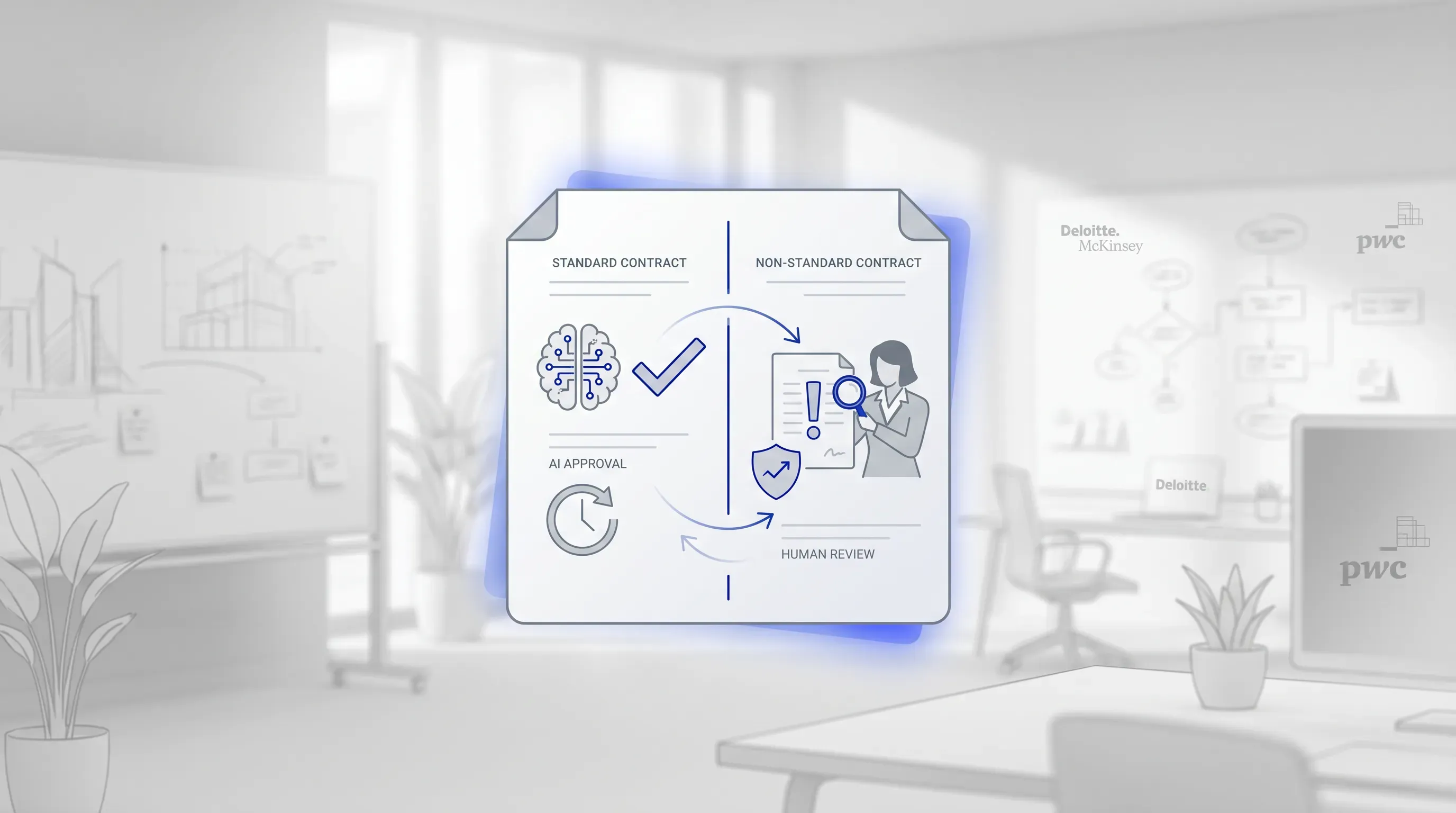
AI checks compliance by extracting the key clauses from a contract and comparing them against your approved standards and legal requirements, then it flags anything missing or non-compliant. The clause-by-clause review that used to take a person an afternoon happens in minutes.
This catches gaps a rushed reviewer misses. The system automatically surfaces a missing liability cap or a payment term outside policy.
McKinsey found that large language models trained on a company's contract database can automatically extract key terms and obligations and continuously compare contracts against real transaction data. The deeper value here is consistency. A human reviewer applies the policy slightly differently on a Friday afternoon than on a Monday morning, while the AI applies the same standard to every contract every time. For a lean team handling high volume, that consistency is worth as much as the speed, because it means the hundredth contract gets the same scrutiny as the first.
How does AI handle exceptions and escalations?
AI handles exceptions by routing any flagged contract straight to the right human with the issue clearly marked. The reviewer opens the contract already knowing what failed and why, so their time goes only to what genuinely needs judgment.
This exception-driven model is the real source of speed. The team stops touching routine work entirely and looks only at the contracts that broke a rule.
The Forrester procurement study quantified what removing manual follow-ups does, with requester effort dropping from an average of four hours to about 30 minutes per request after the workflow was redesigned. That drop reveals where the hours actually went. Those hours were spent on coordination and chasing. When AI delivers the exception pre-marked to the right person, you remove the coordination cost and keep only the judgment, which is the part you were paying people for anyway.
How much faster does AI make approvals?
AI compresses approval turnaround from days or weeks down to hours by removing the idle waiting and email back-and-forth that consume most of the time. The gains come from specific eliminated steps. A forwarded email stops being the gate, and an absent approver's inbox stops parking the contract.
Forrester's LinkSquares analysis documented a composite organization shortening contract cycle time from 12 weeks to under nine weeks through streamlined intake and automated approvals, a 30 percent improvement in processing time. Pair that with the procurement case earlier, where 73 days fell to 23, and a pattern holds across both. The biggest cuts came from the waiting stages. That tells you where to look in your own process. The slowest part of your approval workflow is the time a contract spends doing nothing, and that is the exact time AI removes.
What should you keep human in the workflow?
Keep final accountability and relationship-sensitive decisions with people, with human judgment reserved for unusual or high-stakes terms. AI handles the repetitive routing and checking, while a person owns the call on anything that carries real consequence. The goal is a workflow where automation accelerates the routine without removing oversight from the contracts that matter.
Drawing the line is straightforward. Let AI do the work that has a known right answer, and keep humans on the work that requires weighing trade-offs.
PwC's legal generative AI deployment processed high-volume contract portfolios in 1.5 weeks with human validation built into every stage, which compressed a multi-week effort and preserved accuracy. The design principle worth borrowing is that speed and oversight reinforced each other rather than competing. Because AI cleared the routine volume, the humans had room to focus their attention where it counted. Build your workflow the same way, and you get faster approvals and tighter control at once, instead of trading one for the other.
Automate the final approval and signature with Agrello
Once a contract clears approval, it still has to be signed, and that's the step a fast workflow funnels toward. A quick approval means little if the signature stage drags because of printing or a counterparty who has never met you. This is where execution either holds the speed you've gained or loses it.
Agrello is an Estonian e-signing and contract management platform built for small and mid-size businesses, and it handles exactly this execution stage. Its capabilities cover document automation and e-signatures backed by strong digital identity, which means two parties who have never met can still sign with verified legal validity. Agrello reports that its platform reduces signing time by up to 60 percent.
If you've reached the point where your approvals move quickly but signing still slows you down, that's the gap Agrello closes. Map your approval stages first, then connect automated routing and checks to a signature that's both fast and legally sound. Start with a single high-volume contract type and measure the turnaround before and after.